|
Introduction
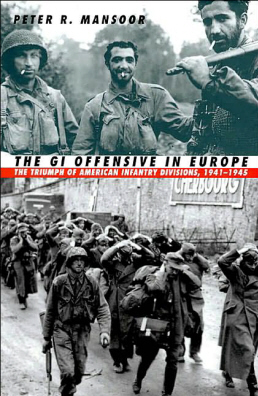
My presentation this evening is
about “The GI Offensive in
Europe,” which is the title of my book
published in 1999 by the University Press of
Kansas. I had originally entitled the
manuscript “Building Blocks of
Victory,” which I think more
accurately portrays the essence of the
thesis that I will discuss. The editors,
however, felt strongly about including the
term “GI” somewhere in the title
– and having spent nine years
researching and writing, I was not about to
argue with them. I was gratified when The
GI Offensive in Europe was honored
as the distinguished book of the year by the
Society for Military History and the Army
Historical Foundation. More importantly, the
work has sparked renewed debate about the
combat effectiveness of American ground
forces in the European Theater of Operations
during the latter stages of World War II
– debate that has implications for the
U.S. Army today as we consider wholesale
changes to the personnel, logistical, and
training systems that grew out of that
experience.
A fashionable argument in the
past two decades has been that the Allies
won World War II only through the sheer
weight of material that they threw at the
Wehrmacht in a relatively unskilled manner.
The more combat effective German army was in
the end bulldozed by less capable, but more
numerous, enemies – or so the argument
goes. All of the immense weight of material
produced by the industrial strength of the
United States, however, was just so much
junk without trained soldiers to operate it
and bring it to bear against the enemy, a
coherent doctrine for its employment, and
leaders who could command the formations
into which it was organized.
The task of mobilizing and
training an army of eight million soldiers
in four years was enormous. More impressive,
however, were the results those soldiers
achieved when pitted in combat against one
of the most tactically proficient armies
ever to exist. In campaigns fought across
the globe American soldiers proved their
capabilities in battle, the ultimate test
for an army and a nation.
Sheer numbers alone could not
ensure the victory of the Allied coalition
in World War II. Rather, the relative
quality of the forces fielded by the Allied
and Axis powers was crucial to the ultimate
outcome. The combat effectiveness of these
forces changed over time right up until the
end of the fighting. In general, Allied
combat effectiveness increased, while huge
casualties and shortages of key resources
eventually caused German effectiveness to
decline. While the causes of the decay of
the Wehrmacht are readily apparent, the
reasons for the increase in Allied combat
effectiveness are less well understood.
Material superiority is an insufficient
explanation for the ultimate triumph of the
armies fielded by Allied powers. It is my
belief that the relative combat
effectiveness of the various armies had a
major impact on the outcome of the war in
Europe.
Comparing the American and
German armies, the difference between the
two forces is apparent. German units could
maneuver well and generally had excellent
leadership, discipline, unit cohesion, and
training. Although German ground combat
units were tactically outstanding, the
Wehrmacht failed as a fighting organization
because of its numerous deficiencies in
other areas such as logistics, fire support,
intelligence, interservice cooperation, and
its inability to adapt to the changing
tactics and operations of its foes as World
War II progressed.
The American army possessed
great advantages in terms of superior
intelligence and the ability to devastate
opponents with fires. American military
leaders were also able to plan and execute
joint operations to a much higher standard
than their adversaries. American
citizen‐soldiers proved to be
adaptable to changing conditions and were
often able to develop new tactics,
techniques, and procedures in the midst of a
campaign. The most critical factor, however,
was the endurance of the American army once
engaged in extended combat.
American commanders in Europe
rarely possessed the numerical superiority
the revisionists claim overwhelmed the
Wehrmacht in 1944 and 1945. Indeed, they
would have resisted the notion that the
American army overwhelmed its adversaries
with sheer numbers or material superiority.
Instead, American leaders used the personnel
and logistical systems they created to keep
a small number of divisions at a relatively
high state of combat effectiveness. The
ability of the American army to sustain its
effort over an extended campaign tipped the
balance in Western Europe. For an army whose
strength was less than that of the Romanian
army only a few short years before, perhaps
the ultimate tribute was the fact that only
one division out of eighty‐nine
completely failed the test of combat [the
106th Infantry Division during
the Battle of the Bulge]. In the final
analysis, American infantry divisions
performed much better than either British or
German military leaders believed they would.
The Historical Debate
The debate over combat
effectiveness started early and has hardly
waned since. The initial assault on the
reputation of the American army came from an
unexpected source. In 1947 Colonel S.L.A.
Marshall, the Deputy European Theater
Historian during World War II, published a
book entitled Men against Fire that
called into question the quality of American
infantrymen. Marshall contended that fewer
than 25 percent of American infantrymen
fired their weapons in any given battle. In
his view, the inability of American infantry
units to gain "fire superiority"
over their adversaries was the primary
reason for their failure to maneuver in
order to close with the enemy and destroy
him. Given the credibility of the source,
for nearly four decades military officers
and historians took Marshall's thesis
as fact.
Three decades later another
military historian, Trevor N. Dupuy, also
cited statistics in his assertion of the
inferiority of American combat units on the
European battlefields of World War II. His
work, Numbers, Predictions, and War,
applied the techniques of quantitative
analysis to the outcomes of
eighty‐one combat engagements in 1943
and 1944. Using a mathematical equation he
called the "Quantified Judgment
Model," Dupuy concluded that German
units were on the average 20 percent more
effective than their British and American
counterparts. Dupuy believed some of the
factors that caused this
"superiority" could be better
utilization of manpower, more experience,
greater mobility, better doctrine, more
effective battle drill, superior leadership,
and inherent national characteristics.
Dupuy was the vanguard of a
group of historians who trumpeted the
tactical superiority of the Wehrmacht at the
expense of the American army. Russell
Weigley gave the American army faint praise
in his now classic work,
Eisenhower's Lieutenants.
Weigley claims that the American army in
1940 could not escape the inheritance of the
western frontier on its military thought.
Although the Civil War taught the Army the
importance of power on an
European‐style battlefield, the
frontier heritage emphasized the importance
of mobility in tactical units. The result of
this legacy was that American divisions
lacked the staying power to fight a war of
attrition against their German opponents,
while the mobility of American units could
not be used to the best effect in the
slugging matches of France and Germany in
1944 and 1945. The pedestrian tactical
abilities of inexperienced American generals
resulted in a battle of attrition, waged by
an army fashioned more for mobility than
staying power. Material resources, Weigley
concludes, enabled the American army to
"rumble to victory," despite its
relative combat ineffectiveness against its
German opponents.
A year later Martin van Creveld
made the most extreme case for the combat
superiority of the Wehrmacht with the
publication of
Fighting Power: German and
U.S. Army Performance,
1939‐1945.
The Wehrmacht, Van
Creveld argues, "developed fighting
power to an almost awesome degree," and
totally outclassed the American army on the
battlefield. Van Creveld believes that the
American army had a managerial view of war
and treated its organizations as parts of a
vast industrial enterprise. American
emphasis on centralized planning,
organization, and logistics relegated its
soldiers to the status of cogs in a vast
machine of war. By contrast, the German
focus on small unit cohesion, training, and
tactics made their combat units much more
effective on the battlefield. Van Creveld
saved his harshest criticism for the
American personnel replacement system.
"Perhaps more than any other single
factor," Van Creveld argues, "it
was this system that was responsible for the
weaknesses displayed by the U.S. Army during
World War II." The American army, by
attempting to maximize its efficiency in the
numerical sense, ended up reducing its
combat effectiveness by lack of attention to
the psychology of the fighting man.
Three British historians, John
Keegan (The Second World War), Max
Hastings (Overlord and
Armageddon), and John Ellis (Brute
Force), all accept the arguments of
Weigley and Van Creveld without much
alteration. The German army, all three
authors contend, was much more competent and
combat effective than its allied
counterparts. The allies won through brute
force by bringing to bear the full weight of
their material resources against the German
military forces, which fought skillfully but
unsuccessfully against overwhelming odds.
Historian Geoffrey Parker once
noted that the half‐life of an
historical theory is roughly ten years, so
it should not be surprising that scholars
have not left the theory of German
battlefield supremacy unchallenged. The
first person to do so was John Sloan Brown
with the publication in 1986 of Draftee
Division, a history of the 88th
Infantry Division during World War II. The
88th Infantry Division, commanded by
Brown's grandfather, Major General John
E. Sloan, earned an excellent reputation
fighting in Italy from the spring of 1944 to
the end of the war. The reason for the
division's success, Brown argues, was
that the War Department's Mobilization
Training Program worked as long as a unit
could stabilize its personnel early and keep
them from being stripped away for other
purposes. The 88th Infantry Division was one
of the more fortunate units in this regard.
With good leadership, sound training both in
the United States and overseas, and a solid
logistical structure behind it, the 88th
Division was an example of the American
mobilization system at its finest.
Despite its contribution to the
debate, Draftee Division was too
limited in its scope to come to any
definitive conclusions about the combat
effectiveness of the American army as a
whole. More recent works have filled in some
of the gaps in the discussion. In a study of
the Seventh U.S. Army's campaign in the
Vosges Mountains (When the Odds were
Even), Keith Bonn compares the
strengths and weaknesses of the American and
German armies which contended for the
northeastern corner of France from October
1944 to January 1945. Not only did the
Seventh U.S. Army emerge victorious in this
campaign, it did so without the aid of
extensive logistical and close air support
and in terrain and weather conditions that
clearly favored a defensive stand by the
numerically superior German forces. The
divisions of the Seventh U.S. Army, Bonn
argues, were more combat effective than
their German counterparts in Army Group G.
The American replacement system functioned
better in maintaining those divisions at an
adequate strength level, their uniform
organization was superior to the ad hoc
organizations employed by Army Group G, and
American commanders were more tactically
flexible and were able to use their
initiative more often than their German
counterparts. Bonn concludes that in a
campaign fought without the combat
multipliers available to other American
armies, without numerical superiority, and
in atrocious weather and terrain conditions,
the Seventh U.S. Army proved its superiority
against its counterpart, Germany Army Group
G – and it did so when the odds were
even.
Published the same year as
Bonn's book, Closing with the
Enemy by Michael Doubler examines
how the American army was able to adapt to
different conditions in France and Germany
in 1944 and 1945. What was most impressive
about the American combat performance,
Doubler argues, was the American ability to
learn from their mistakes and adapt new
tactics, techniques, and procedures in the
face of unexpected conditions on the
battlefield. Adaptability was crucial to the
success of American combat units. After a
period of adaptation, American divisions
became effective instruments of national
policy, able to close with and destroy the
enemy in a variety of combat environments.
In Why the Allies Won,
Richard Overy also tackles the commonly held
view that the Allies defeated the Axis
powers through sheer weight of industrial
abundance. Although Allied victory in 1945
seems inevitable from the distance of half a
century, it was not so clear to those
nations that fought the war. The vast
potential of Allied resources had to be
turned into combat power. The gulf in
fighting power, Overy argues, narrowed as
the war progressed, with the Allies closing
the qualitative gap with the German army by
1944. The German army, on the other hand,
stagnated due to its unwillingness or
inability to change. In the end, the
Wehrmacht proved skillful in retreat, but
withdrawals do not win wars. Imbued with the
will to win and certain that their cause was
just, the Allied nations turned their
economic potential into combat power and
thereby gained the ultimate triumph.
I would also add the works of
Stephen Ambrose – no stranger to the
D‐Day Museum – into this
counter‐revisionist school,
particularly his two seminal works,
D‐Day and its companion
successor, Citizen Soldiers. As
important as these works are, what was
lacking in the argument for American combat
effectiveness is a comprehensive approach to
the subject. Revisionist historians have
focused too heavily on the early struggles
of the Army of the United States in World
War II, such as the campaign in North Africa
or the Normandy invasion, to the exclusion
of later operations in 1944 and 1945.
Additionally, some historians have mistaken
Allied mediocrity in devising operational
concepts for tactical ineptitude at the
division level and below. Due to decisions
on allocation of resources made early in the
war, American divisions operated with severe
handicaps; nevertheless, nearly all of them
developed into effective fighting
organizations that accomplished their
missions on battlefields literally oceans
apart.
Mobilization and Training
Given the resource and time
constraints under which it operated, the
Army of the United States adequately
developed the large number of combat
formations required to fight a global war.
The most important limitation by far was
time. The United States was the last major
combatant to enter World War II and began at
a relatively low level of mobilization and
readiness. Production of equipment for
lend‐lease competed with the needs of
combat divisions and air groups.
Construction of training facilities took
place simultaneously with the activation of
numerous new military formations. Personnel
needs of the services competed with each
other and with the needs of war industries.
As a result of this turmoil, new divisions
took a longer time to organize and train
than called for by the Mobilization Training
Plan and the Army eventually had to scale
back the number of divisions it activated.
Despite these drawbacks, the
process of creating new divisions was sound.
When the system worked properly, divisions
were able to progress through their training
relatively unmolested by personnel
turbulence, received adequate time to train
small units at their home stations, and then
deployed to take part in army level
maneuvers. When the mobilization plan fell
short of its stated goals, the problem
usually rested in constant personnel
turnover as the War Department called upon
divisions in training to provide large
numbers of replacement soldiers, officer
candidate and air cadet drafts, and cadres
to form new units.
Army Ground Forces under
Lieutenant General Lesley J. McNair
attempted to create each combat division
with the same pattern to ensure that they
were equally combat effective. In an attempt
to economize manpower, however, General
McNair centralized many assets – such
as independent tank and tank destroyer
battalions – at army level under the
assumption that every division did not need
these assets all the time. What General
McNair failed to see was the need for the
combat division to be as
self‐contained as possible to foster
the teamwork and cohesiveness necessary for
successful functioning on the battlefield.
The results of this centralization were
inadequate numbers of tank battalions to
support infantry divisions and a bloated,
centralized supply system that lacked the
flexibility the combat divisions required of
their own organic logistical organizations.
American infantry divisions successfully
improvised to meet the demands of the
battlefield with the organic and attached
assets at their disposal.
Throughout the war, American
infantry divisions in World War II routinely
operated with numerous attachments in combat
– to include artillery, tank, tank
destroyer, engineer, and
anti‐aircraft units – which
gave them much greater power than one would
surmise from a look at their tables of
organization. Additionally, the conversion
to the triangular infantry division –
an organization that contained three
infantry regiments instead of four as in the
ponderous units of the AEF in World War I
– did not cause a lack of staying
power in the Army of the United States
during World War II, contrary to Russell
Weigley’s thesis in
Eisenhower's Lieutenants. In his
comments on the 1940 maneuvers, General
McNair stated:
Both square and triangular
divisions embody a high degree of strategic
and tactical mobility; great fire power; and
when employed properly, adequate ability to
sustain combat…The impression that the
triangular division is weak is erroneous.
While the triangular division is the
smaller, a given man power permits
correspondingly more triangular divisions
than square divisions. Thus a given front
can be held equally strongly by both types
with the same total number of men. Fewer
square divisions, each occupying a larger
front, give the same strength as more
triangular divisions, each occupying a
smaller front.
Weigley's argument would
only hold true had the Army substituted
square for triangular divisions on a
one‐for‐one basis. The extra
infantry strength of the square division
would then have allowed an internal unit
replacement system at the division level.
The revival of the square
division was proposed and rejected after
World War II. In a G3 conference held in
June 1945 with representatives from three
corps and six infantry divisions, Army
Ground Forces inquired regarding the
advisability of adding a fourth infantry
regiment to the triangular division for the
purpose of allowing regimental rotations.
Every officer but one responded negatively
to the idea. Although they considered the
goal of rotating units in combat an
admirable one, "they would not take the
idea seriously because they were unanimous
in the belief that higher commanders would
be unable to resist the temptation to use
the extra regiment tactically instead of
restricting it to its intended role."
Given the constraints of the ninety division
gamble, the Army of the United States simply
lacked enough divisions in 1944 and 1945 to
operate a unit replacement system.
Individual replacements were the only other
recourse.
The United States mobilized
eighty‐nine army divisions during
World War II, a decision based more on the
erroneous belief that American industry
could not cede more manpower to the military
without incurring shortfalls than by any
rational calculation of battlefield needs.
The official historian of the Army believes
that the performance of its combat divisions
on the field of battle in 1944‐1945
"vindicated the bold calculation in
Washington" not to produce more units.
This conclusion is highly debatable. The
decision to cap the Army at ninety divisions
had ramifications beyond whether or not the
United States and its allies would win the
war. The limitation on the number of
divisions, when combined with the inability
of President Franklin D. Roosevelt and his
chiefs of staff to adhere to the
"Germany first" strategy, resulted
in a shortage of divisions when the western
allies conducted their crucial campaign in
France in 1944. This situation forced
American commanders to keep their divisions
engaged in battle more or less continuously
during the campaign.
As weeks and then months passed,
the combat effectiveness of American
divisions rose and fell as they lost men to
enemy fire, disease, cold weather injuries,
and exhaustion, and integrated hundreds of
thousands of replacements into their ranks.
A greater number of divisions would have
enabled American commanders to rotate units
more frequently for periods of rest,
refitting, and retraining, thereby reducing
the rate of casualties. Due to the ninety
division gamble and the employment of nearly
one‐third of the Army along with all
six Marine divisions in the Pacific,
systematic unit rotation was impossible in
the European Theater of Operations.
Lack of personnel stability also
weakened many divisions, especially those
mobilized after Pearl Harbor. These
divisions endured high personnel turnover as
the War Department stripped them for
replacements to meet the pressing needs of
overseas battlefields. Lack of personnel
stability complicated the training of these
divisions, often forcing them to repeat
basic training for new inductees at the
expense of more advanced collective training
for battalion and regimental combat teams.
Shortages of equipment also
plagued the Army in 1942 and early 1943, and
many units trained with equipment different
from that with which they went into combat.
Training facilities were initially
inadequate, but expanded rapidly as the Army
mobilized. Huge maneuver areas located
across the United States allowed the Army to
conduct sustained large‐scale,
multi‐division maneuvers for the
first time in its history. Facilities and
training improved as mobilization progressed
and reached a peak in early 1944 as the Army
prepared for the invasion of France.
In the end, however, Army Ground
Forces only partially met its goal of
sending fully trained and combat ready
divisions into combat. Divisions attained
various degrees of combat readiness based on
numerous factors and although most of them
achieved an adequate baseline proficiency,
the certification of some divisions as
combat ready was a paper drill that masked
their inadequacies. Not that the War
Department had much choice in the matter; by
the end of 1944 during the Battle of the
Bulge the need for divisions in Europe was
so great that the Chief of Staff, General
George C. Marshall, sent Allied commander
General Dwight D. Eisenhower every division
left in the strategic reserve, regardless of
its state of readiness.
Replacements
With so few divisions in the
line, the War Department worked hard to keep
them at full strength. The Army was able to
avoid breaking up units for replacements, an
expedient that plagued the American
Expeditionary Forces in World War I. The
Army trained approximately 2,670,000
enlisted men as replacements from 1941 to
1945, more than twice the number of men
assigned to the eighty‐nine combat
divisions at the end of the war.
Replacements could keep a
division numerically at the correct
strength, but the proportion of
well‐trained and combat experienced
soldiers declined as minimally qualified
replacements entered the ranks. Soldiers
entering combat for the first time without
adequate training and teamwork experienced
an inordinate amount of casualties. Without
enough divisions available to rotate units
out of combat on a regular basis, however,
there was little choice other than to
integrate individual replacement soldiers
into the combat divisions fighting on the
front lines. The American army could
certainly have administered its replacement
system better, but given the assumptions
underpinning the Army's end strength,
the decision to implement a system of
individual replacements was the correct one.
Once an infantry division of the
Army of the United States entered combat in
Europe and sustained losses, it could never
maintain a high level of combat
effectiveness unless it integrated its
replacements in a suitable manner. Although
replacement soldiers were treated poorly by
the system through which they traveled to
their final destination, divisions adopted
various expedients to integrate replacements
more smoothly. Some divisions formed
training centers to indoctrinate and train
replacements, rehabilitate combat exhaustion
cases, and train junior officers and
noncommissioned officers before they assumed
leadership positions. Most divisions came to
realize that they had to treat incoming
replacements well and ensure their smooth
integration into combat units behind the
front to enable them to train with their
units, learn survival skills from combat
experienced veterans, understand their role
in the team, and get to know their leaders.
Failure to do so meant an increase in
casualties and a drop in combat
effectiveness, for once engaged in combat,
divisions were only as good as the
replacements they received to keep them up
to strength. The alternative was to leave
units in the line without giving them
replacements, as the Wehrmacht often did.
The German system of employing
numerous kampfgruppen, small units
formed from the fragments of divisions or
regiments that had once been at full
strength, was vastly inferior to the
American system of keeping every combat
division effective through the infusion of
individual replacements. Not only did the
American replacement system function better
in maintaining U.S. divisions at an adequate
strength level, the uniform organization of
American units was superior to the numerous
ad hoc organizations employed by Germany as
the war progressed. The employment of
kampfgruppen as an emergency measure
may be a justified necessity, but one should
not view crisis management of combat forces
as a superior method to the careful
administration of individual replacements on
a continual basis.
The United States was the only
nation able to maintain its fighting forces
near full strength throughout the war, a
fact which greatly impressed German
commanders. The individual replacement
system had its flaws, but these flaws
stemmed from poor administration of the
system rather than an inherent flaw in the
concept. The task for division commanders
was to take these replacements and integrate
them in such a manner as to maintain the
combat effectiveness of their organizations.
By doing so American commanders were able to
maintain the combat effectiveness of their
organizations even as the Wehrmacht slowly
disintegrated.
Compounding the difficulties
many divisions faced in mobilization and
training was the fact that only a few of
them received any combat experience before
D‐Day. The fierce battles of
attrition in Normandy pitted mostly untested
Allied divisions, backed by a healthy
superiority of artillery and airpower,
against under‐strength German units
leavened with combat experienced leaders and
possessing many technologically superior
weapons. The Allies prevailed by wearing
down the German army in bloody fighting
among the hedgerows, and then penetrating
through the weakened German line with
American armored and infantry divisions.
Organizational
Effectiveness of AUS Divisions and
their German Counterparts
Comparisons of the relative
merits of the German and American forces
that faced each other in Normandy can be
misleading. Germany began its rearmament
program in 1933 when Hitler came to power
and enjoyed six years of peace in which to
expand the 100,000 man Reichswehr,
but even that rather luxurious time interval
strained the competence of the force. German
divisions fought in campaigns in Poland,
Norway, France, the Balkans, Africa, and
Russia prior to D‐Day. They suffered
many casualties, but by June 1944 the
Wehrmacht had combat veterans in command of
its units and an established,
combat‐tested tactical doctrine. Most
German units had solid noncommissioned
officer leaders and well‐trained
soldiers, kept in line through ideological
indoctrination and rigid (and often brutal)
discipline. German equipment was among the
most technologically advanced in the world,
especially their tanks and machine guns.
The Army of the United States
lacked most of these advantages when
compared to the Wehrmacht. Germany began
rearmament six years before the Polish
campaign. American rearmament, on the other
hand, began in June 1940 after the fall of
France, and within two and a half years the
first American divisions engaged in combat
in North Africa against an experienced
enemy. The United States rapidly produced an
army of citizen‐soldiers. Few
American divisions had received a baptism of
fire before D‐Day. Significantly, of
those divisions sent to Normandy that had
been in combat before (the 1st and 9th
Infantry Divisions, the 82nd Airborne
Division, and the 2nd Armored Division), all
performed well. The Army also still had to
work out critical elements of its doctrine,
such as anti‐armor defense, at the
unit level. Most American divisions lacked
combat tested leadership, had not weeded out
all of the incompetent leaders, and found
training difficult due to the shortage of
space in Great Britain. One wonders how the
German army would have fared had it been
forced to fight under similar circumstances
in the Rhineland, Austria, or Czechoslovakia
between 1936 and 1938.
Few divisions were fully
effective upon their entry into combat, but
on the whole Army Ground Forces succeeded in
developing divisions that could attain a
high degree of effectiveness after
their initial battles. Differences in
effectiveness were a function primarily of
the leadership exercised by the division
commander and combat experience. Unit
effectiveness changed over time as leaders
emerged, casualties left and replacements
arrived, combat taught new lessons, and
units trained to new standards. The cyclical
nature of combat effectiveness was common to
all of the divisions that fought in Europe,
an unavoidable result of high casualties and
the functioning of the individual
replacement system. By way of example,
between June 1944 and May 1945, the 9th
Infantry Division sustained over 33,000
battle and non‐battle casualties,
nearly two and one‐half times its
authorized strength. Given this amount of
turnover, sustainment of combat
effectiveness remained a significant
challenge.
One enormous advantage that
American divisions had in combat was their
vastly superior fire support, made possible
by the advances in fire support coordination
and technique during the interwar period.
American artillery was the best in the world
by the time the Army entered into combat
overseas. Tooled with new, more powerful,
more mobile weapons, and directed through a
combination of radio‐equipped forward
observers and fire direction centers,
American artillery had the ability to mass
fire on the enemy that impressed both friend
and foe alike. This firepower largely
negated the superior ability of German units
to maneuver at the small unit level. Most
American commanders, however, eventually
learned that they must strike a balance
between maneuver and firepower or risk
failure in combat.
Despite S.L.A. Marshall’s
arguments to the contrary, American
infantrymen in World War II fired their
weapons as necessary to survive and
accomplish their mission. The fact is,
however, that small arms fire from the
M‐1 rifle was not the determining
factor in whether American units achieved
"fire superiority" on the
battlefield. Firepower for infantry units
came from many sources, most of them
external to the infantry battalion itself,
and chief among which was the excellent
artillery support which American units
enjoyed throughout the war. Reflecting on
his experience as an infantry battalion
commander in World War II, General William
E. Depuy concluded that what he really
accomplished "was that I moved the
forward observers of the artillery across
France and Germany." The artillery
massed firepower that the infantry lacked,
and although the infantryman was essential
to take and hold ground, he was not the
primary killing instrument of the American
army in the ETO. The Army of the United
States achieved its dominance in firepower
over the German army through the skillful
use of all of the fire resources at its
disposal. The victory belonged to the
combined arms team – not any one part
of it.
American divisions had other
advantages in battle, advantages sometimes
overlooked by historians who focus too
narrowly on the tactical maneuvers of armor
and infantry units in battle. The Allies had
an outstanding intelligence system, although
noticeable failures in 1944 at Arnhem and in
the Ardennes tarnished its reputation
somewhat. The information provided by ULTRA
was of tremendous value to those commanders
who possessed knowledge of it. At corps
level and below, a steady stream of enemy
prisoners, patrol reports, and superior
aerial reconnaissance also provided a great
deal of information to American commanders.
American logistics and transportation assets
surpassed those of any other nation.
Although certain American weapons, such as
tanks and machine guns, were not as
effective as their German equivalents,
American soldiers successfully used the
weapons at their disposal to close with and
destroy the enemy. The American armed forces
also proved their ability to operate in a
joint environment with air and naval forces,
although this took longer than it should
have in the case of the development of an
effective close air support system. Looked
at in its totality, the combat effectiveness
of the Army of the United States in 1944 and
1945 was impressive.
The experience of senior
American commanders was also an important
element in the development of combat
effectiveness in the Army of the United
States. Senior American leaders lacked
experience in commanding large formations
due to the scarcity of resources in the
interwar Army. They had learned their
profession mostly through intensive study in
the Army's professional school system.
How they would perform in battle was
anybody's guess. During the war,
American commanders at the operational level
of war (army and army group level) made many
mistakes – such as the failure to
complete the encirclement of the Germany
army in Normandy – that unnecessarily
prolonged the war. Commanders at division
level and below, on the other hand,
displayed the ability to learn from their
experiences and change their tactics and
techniques, sometimes even in the midst of
combat such as during the bitter fighting in
the hedgerows during the Normandy campaign.
Without a doubt, one of the strong suits of
the Army of the United States in World War
II was its ability to improvise solutions to
tactical problems on the battlefield.
American infantry divisions adapted to
combat in a variety of environments and
innovated extensively to get their missions
accomplished. American tactical commanders
learned how to combine the efforts of the
various arms and services to defeat the
enemy and accomplish their missions.
Conclusion
Given the difficulties of rapid
mobilization, the achievements of American
combat divisions appear in a different
light. By the late summer of 1944 the Army
had largely overcome its handicaps and had
reached a high level of military
effectiveness – superior to that of
its enemies. A more balanced comparison of
German and American forces would compare
each organization at its zenith, say, the
German army in June 1941 and the American
army in April 1945. I submit that one would
be hard pressed to choose between the two
forces on the basis of technical or tactical
proficiency at the division level. Given the
pernicious ideological bias of the German
army, however, the choice would in fact be
easy to make for the people of a democratic
society. The Army of the United States
reached its zenith of combat effectiveness
without the extensive ideological
indoctrination and fear‐based
discipline that infused many German units
with their will to fight.
Few American commanders of the
World War II era would agree with the
contention that the German army was more
effective. While the cream of the Wehrmacht,
the panzer and panzer grenadier divisions,
were effective organizations and a match for
the divisions of the Army of the United
States, the bulk of the German army was not
composed of these units. The average German
infantry division could not defeat an
American infantry division in battle, while
American infantry divisions consistently
proved their ability to accomplish their
missions against the enemy divisions in
front of them. In terms of mechanization and
their ability to conduct mobile warfare,
American infantry divisions were in a class
by themselves. Nor could the German army
consistently sustain its fighting power. The
Wehrmacht could field superb formations
equipped with technologically advanced
weapons, but its failure to provide the
means for their logistical sustainment led
to their undoing.
The sheer magnitude of American
industrial mobilization may cause one to
overlook the quality of the end product. The
abundance of industrial resources gave the
Army of the United States a large quantity
of equipment and munitions, but Army leaders
still had to form units capable of using
these weapons in an effective manner.
Beginning with mobilization in
mid‐1940, Army leaders turned the
potential of industrial and manpower
resources into the capabilities of combat
power as expressed in the divisions of the
Army of the United States. Over time, these
formations developed into lethal fighting
organizations. The American army in Europe
never had enough divisions at its disposal
simply to overwhelm its adversaries with
mountains of men and material. It
accomplished its mission of assisting in the
destruction of Axis forces through the
superior effectiveness of its ground combat
divisions, backed by powerful air and naval
forces which ruled the seas and skies of
Europe. American industrial capability did
not assure victory; rather, material
abundance enabled the United States to
maintain the effectiveness of its divisions
overseas in extended and grueling campaigns
fought thousands of miles from the homeland.
The great achievement of the
Army of the United States in World War II
was to rapidly mold a large army of citizen
soldiers into an effective fighting force.
American divisions, led by a small slice of
Regular Army and National Guard cadre and
filled with draftees and the products of
officer candidate schools, performed
competently on the battlefield once they
overcame the initial shock of combat. The
first battles were for the most part
traumatic affairs, but American divisions
displayed the ability to learn from their
mistakes and improve their performance in
future battles. Lieutenant General Lucian K.
Truscott, Jr., who fought in operational
command of American soldiers from the
invasion of North Africa to V‐E Day,
recognized this progression. "When
American soldiers first came in contact with
the German soldier," Truscott wrote,
the latter was already a veteran
with a long military tradition, the product
of long and thorough military training, led
by experienced and capable officers, and
equipped with the most modern weapons. The
German was then better trained especially
for operations in small units, and the
quality of his leadership was superior.
German soldiers displayed an ingenuity and
resourcefulness more American than British.
The American quickly adapted himself and
learned much from the German. Sicily and
southern Italy proved that he had mastered
his lessons well. From Anzio on there was
never a question of the superiority of
American soldiers.
There was never a question, that
is, in the minds of American commanders. It
remained for the defeated German army and
its apologists to perpetuate a flawed theory
that the Army of the United States had
blundered its way to victory by throwing
mountains of material at the superior but
hopelessly outnumbered forces of the
Wehrmacht.
The Army of the United States
succeeded in World War II due to its
development of combat effective
organizations that could not only fight and
win battles, but sustain that effort over
years of combat. Logistical superiority
helped to give American ground combat
divisions endurance, but did not assure
victory on the battlefield. With only
forty‐two infantry divisions, sixteen
armored divisions, and three airborne
divisions in the ETO, American commanders
had to ensure that the combat effectiveness
of their units matched or exceeded that of
their enemies. The key to this development
was the transformation of the standard
American infantry division from untested
organization to a fighting unit capable of
closing with and destroying the enemy in a
variety of combat environments. Throughout
the battles for North Africa, Italy, France,
and Germany, the infantry divisions of the
Army of the United States became the
building blocks of victory upon which
American commanders crafted their operations
to annihilate the Wehrmacht and achieve
ultimate victory in the largest and most
destructive war in human history.
Col.
Peter R. Mansoor
is the author of The GI Offensive in
Europe:The Triumph of American Infantry Divisions,
1941‐1945 published by the University of
Kansas Press. He received his Ph.D. in history
from Ohio State University, taught military
history at West Point, and was special assistant
to the director for strategic plans and policy.
The Joint Staff, 1997‐1999. He is an
active duty colonel in the United States Army
and former commander of 1st Brigade, 1st Armored
Division in Iraq in 2003‐4. He is
currently s a senior military fellow at the
Council on Foreign Relations.
Col Mansoor's
comments on the Training of Iraqi
Forces
can be seen at this
link at the Council on Foreign
Relations
|

 Return to the New York Military Affairs Symposium start page