|
Guilford Courthouse
US Department of the Interior
National Park Service
Handbook 30, 1961
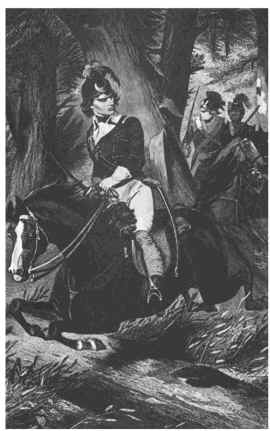
19th‐century
illustration of Colonel Francis Marion, "The
Swamp Fox", riding through South Carolina.
Overview of Guilford Courthouse
The British won a hollow victory at the Battle of Guilford
Courthouse on March
15, 1781. They left the field so weak that they were unable
to vigorously
continue their subsequent campaign in the Southern Colonies.
Guilford Courthouse
Introduction
The Battle of Guilford Courthouse, fought March 15, 1781,
marked the
beginning of the end of the Revolutionary struggle. It was a
British victory,
but a victory which left the enemy so weak that it caused
them to lose the
campaign in the Southern Colonies ‐ a victory that
started the armies of
Cornwallis on the road to Yorktown and surrender.
Inscribed on the Nathanael Greene monument in the park is
this statement
on the significance of the battle by C. Alphonso
Smith:
In the maneuvering that preceded it, in the strategy that
compelled it, in the
heroism that signalized it, and in the results that flowed
from it, the Battle
of Guilford Court House is second to no battle fought on
American soil. Over
the brave men who fell here their comrades marched to
ultimate victory at
Yorktown, and the cause of constitutional
self‐government to assured triumph
at Philadelphia. To officer and private, to Continental
soldier and volunteer
militiaman, honor and award are alike due. They need neither
defense nor
eulogy but only just recognition. . .
The Southern Campaign
The campaign climaxed by the Battle of Guilford Courthouse
began more
than 2 years earlier. In 1778, with the war approaching a
stalemate in the
North, the British authorities adopted a new plan to transfer
operations to
the South, an area relatively untouched by the war up to that
time. They
planned to overrun the Southern Colonies successively from
Georgia northward
in the belief that little more than a parade of British might
would be
necessary to restore those Colonies to normal relations with
the Crown.
Sweep Through Georgia
Accordingly, an expeditionary force sent to Georgia under Sir
Archibald
Campbell captured Savannah during the last week of 1778. With
the assistance
of Gen. Augustine Prevost, who had marched northward from
Florida with 2,000
men, Campbell completed the conquest of Georgia during the
first half of 1779.
In April, Prevost entered South Carolina and devastated it;
but, failing to
take Charleston, the key city of the region, he was compelled
to return to
Georgia. In September, the Americans, aided by a French
fleet, attempted to
retake Savannah, but they were repulsed with severe losses.
Siege of Charleston
In December Sir Henry Clinton, commander in chief of British
forces in
America, sailed south from New York with 8,000 men. He landed
at Tybee Island
at the mouth of the Savannah River. After obtaining
reinforcements from
Prevost, he proceeded against Charleston. Gen. Benjamin
Lincoln, the American
commander, should have abandoned Charleston, but instead he
collected all the
troops he could and shut himself up in the city, where he
surrendered on May
12, 1180, after a brief siege.
Having obtained his objective, Clinton returned to New York,
leaving the
Earl of Cornwallis in command, with the task of consolidating
the gains in the
South and continuing the conquest. Cornwallis established a
series of
military posts throughout South Carolina, but he was
constantly annoyed and
harassed by guerrilla raids led by such famed partisan
leaders as Francis
Marion, Thomas Sumter, Andrew Pickens, and Otis Williams.
Charleston remained
the British base of operations and supply depot, while
activity in the
interior centered at Camden.
Battle of Camden
In June, Gen. Horatio Gates was appointed commander of
patriot troops in
the South. He determined to liberate the South, beginning
with a move in
force against the British stronghold at Camden. This was,
strategically and
tactically, a sound conception, but in its execution Gates
failed completely.
His defeat at Camden on August 16, 1780, was one of the most
disastrous
battles in which an American army has ever been engaged. This
defeat
terminated all organized opposition to British control in
South Carolina and
cleared the way for further advances. In September,
Cornwallis moved his main
army from Camden to Charlotte. Simultaneously, a flank
column, under Maj.
Patrick Ferguson, was marching from Fort Ninety‐Six
through the Piedmont,
carrying the war into the upcountry. This column was expected
to join
Cornwallis at Charlotte.
[See Southern Map: American and British troop movements in
the Southern
campaign to the Battle of Guilford Courthouse.]
[See Southern Table: Southern Campaign to the Battle of
Guilford Court House]
Battle of Kings Mountain
Ferguson's advance aroused the back‐country
mountaineers, hitherto not
particularly concerned with the war. Separated by time and
distance from the
more thickly populated coastal plains, these settlers had
their own problems
and their own troubles ‐ notably the Indians.
Ferguson's appearance in their
own region was, however of vital concern to them. They
forthwith assembled in
small bodies, each under its own leader, for the purpose of
repelling the
invasion. Eventually, about 2,000 of them gathered from the
frontiers of the
four southernmost States and at once set out in pursuit of
the invader who had
learned of the gathering and had turned toward Charlotte.
Ferguson took
position on Kings Mountain to await reinforcements and there
was discovered
and immediately attacked by about 1,000 backwoodsmen on
October 7.
The position Ferguson chose for his stand was almost ideally
suited to
the type of fighting at which his adversaries were most
adept. As a result,
at the end of approximately an hour Ferguson was dead, about
400 of his men
were slain, and more than 700 captured. On learning the news
of this
disaster, Cornwallis fell back from Charlotte to Winnsborough
to await
reinforcements.
Greene Appointed Southern Commander
A few days after Cornwallis withdrew from North Carolina, the
Continental
Congress made an important move affecting the war in the
South. The fiasco at
Camden had caused that body to lose faith in Gates, and Gen.
George Washington
was requested to nominate a successor. Nathanael Greene was
Washington's
choice, and Congress accordingly appointed him commander of
the Southern
Department.
Greene reached Charlotte early in December. There he found
the remnant
of Gates' force which had been joined by some additional
militia. The men
were low in morale and poorly equipped. Obviously, the
Americans were in no
condition to encounter the main British force. Therefore
Greene decided to
wage guerrilla‐type warfare against Cornwallis'
exposed western outposts.
Dividing his army, Greene sent Gen. Daniel Morgan with about
half of the men
to the southwest toward Fort Ninety‐Six. Meanwhile
Greene conducted the
remainder to a position on the Peedee River near the present
site of Cheraw,
S.C. This move was undoubtedly dangerous and violated the
basic rule of
strategy which forbids the division of a force in the face of
a superior
enemy; but it forced Cornwallis to act, for the Americans
were distributed in
a way that endangered his entire forward line. That line ran
from Georgetown
through Camden, Winnsborough, and Fort Ninety‐Six to
Augusta.
Battle of Cowpens
The British commander's answer to this threat was to
divide his own army.
He sent Col. Banastre Tarleton with a strong column to
operate against Morgan,
while he intended to move into position to intercept the
Americans whom he
expected Tarleton to drive northward. Unfortunately for
Cornwallis' plan,
Morgan roundly defeated Tarleton in a battle at Cowpens, and
then escaped
because Cornwallis had delayed about 48 hours in moving the
main British force
northward. The Battle of Cowpens took place in
mid‐January 1781, and in it
the British suffered a reverse almost as serious as that of
Kings Mountain 3
months earlier.
Race for the River Crossings
Morgan began a rapid retreat northward and eastward
immediately after
Cowpens, with Cornwallis in close pursuit. The two armies
were then about 25
miles apart. Twenty‐three days later, after the
Americans had marched about
125 miles airline distance, they had gained 3 miles. When he
began to
retreat, Morgan sent news of his victory and of his future
plans to Greene.
Thereupon, Greene set his force in motion northward under
Gen. Isaac Huger,
while he, himself with a small escort, joined Morgan near
Beatty's Ford on the
Catawba River near the present site of Moorseville, N.C. The
Yadkin River was
crossed a few miles from Salisbury at the Trading Ford, where
an overnight
rise of 2 feet in the stream prevented the passage of the
pursuing British.
From that point the Americans continued to Guilford
Courthouse, where they
were joined by the other half of the army from Cheraw, and
whence the retreat
was continued toward Virginia.
Cornwallis, unable to use the Trading Ford because of the
high water,
ascended the Yadkin River to the Shallow Ford, several miles
west of the
Moravian settlement at Salem.
By this time Greene's plans were fairly evident. He
wished to avoid
battle, to draw the British as far as possible from their
base, and to be able
to retire into Virginia if the necessity should arise. To
prevent Greene from
escaping and in the hope of forcing an engagement, Cornwallis
continued the
pursuit which developed into a race for the river fords.
The Dan River was deep and could be forded only on its upper
reaches;
therefore the Englishman interposed his army between Greene
and these fords in
the expectation that he might compel the Americans to fight.
Greene, however,
had prepared for just such a contingency and at his direction
boats had been
built and collected on the south bank of the Dan. In them the
Americans
safely crossed the river. Cornwallis gave up the chase and
marched back to
Hillsborough, where he raised the Royal Standard and issued a
proclamation
calling upon all loyal subjects to rally to his assistance.
The results,
however, were so disappointing that within a few days his
army was again on
the march, partly from the necessity of securing food.
Meanwhile, Greene collected reinforcements and rested his
army in
Virginia. His main object had been to draw Cornwallis away
from his base,
and, fearing now that he might return to it, Greene recrossed
the Dan about
March 1. For about 2 weeks he kept on the move, playing for
time and
position, and avoiding decisive action until he could be
joined by the last of
the summoned militia reinforcements. These reinforcements
arrived in camp on
March 13 and 14, and the whole American force immediately
marched to Guilford
Courthouse where battle stations were taken. Cornwallis was
informed of this
on the 14th, and early on the next morning he marched from
his camp on Deep
River to the engagement he had so long sought.
[See Tarleton Map: This plan of battle, engraved for Henry
Lee's Memoirs of
the War, is a copy of the so‐called Tarleton Map,
which was published in
London in 1787. It is not wholly accurate, and the north
point should be
rotated 50 degrees to the left for proper orientation.]
The Battle of Guilford Courthouse Begins
Lt. Col. Henry Lee opened the battle with an advance guard
action against
the British near the Quaker settlement of New Garden, 3 miles
west of the
American position. This skirmish resulted in no advantage to
either side.
The Americans retired, and the British continued to advance
along the New
Garden Road toward the courthouse.
American Lines
Greene's troops were drawn up in three lines,
approximately 400 yards
apart, facing west. The first two lines extended north and
south across the
New Garden road; the third line was entirely north of the
road, following the
crest of a low hill. Heavily wooded terrain limited the
effectiveness of
cavalry. The woods likewise reduced the effectiveness of
artillery since the
field of fire, particularly for the attacking force, was
poor. Approximately
one‐half mile in front of the position was a small
stream from which the
ground rose steadily, though rather gradually, to the crest
of a hill where
the first line was drawn up. Three cultivated fields, one to
the north and
two to the south of the road, provided an excellent field of
fire for parts of
that line, and the rail fences enclosing the cultivated land
afforded the
troops some protection. The second line was entirely in the
woods, and the
third was near the eastern edge of a good‐sized
clearing.
Both flanks of the first two lines and the right flank of the
third were
unprotected. But the heavy woods dictated a direct frontal
attack by the
British; therefore these exposed flanks were not a
disadvantage for the
Americans. The left flank of the third line rested on the New
Garden Road and
was protected by artillery during the later stages of the
battle.
The First Line consisted of two brigades of North Carolina
Militia,
almost all of whom were wholly untrained and entirely without
battle
experience. On the left flank were stationed Lt. Col. Henry
Lee's Legion and
Col. William Campbell's Riflemen. The former were
regulars and the latter
were frontiersmen from the Virginia and North Carolina
mountains who had had
appreciable campaign experience, including participation in
the Battle of
Kings Mountain. The right flank detachment was composed of
Lt. Col. William
Washington's regular cavalry, the remnant of the
Delaware regiment of
Continentals, and Col. Charles Lynch's Riflemen,
comparable in experience and
capacity to Campbell's. In the center on the road, a
section of artillery,
two 6‐pound guns, commanded the stream‐crossing
below.
The Second Line was made up entirely of Virginia Militia, the
majority of
whom were as untrained and inexperienced as were the North
Carolinians in the
front line. The Virginia officers, however, were largely men
who had served
in the Continental Army, and a number of them had had some
battle experience.
Also in the ranks of the Virginians were a few men who had
had previous
military service. Thus the second line was somewhat stronger
than the first
by virtue of this leaven of experience. Finally, Brig. Gen.
Edward Stevens,
in command of one brigade, placed sentinels a few yards in
the rear of his
line to insure against any break by his men.
The Third Line was composed of Greene's two small
brigades of Continental
troops. Of the four regiments, one, the 1st Maryland, was a
veteran unit.
The 2d Maryland and the two Virginia regiments were recently
reorganized, had
excellent officers, and contained a good proportion of
veterans in the ranks.
The total force, regular and militia, infantry, cavalry, and
artillery,
numbered about 4,400. Of this total possibly 1,500 to 1,600
of all arms were
regulars, but many of these fell into the recruit
classification.
British Lines
Lord Cornwallis commanded an army, numerically inferior to
Greene's; but
it was vastly superior in organization, discipline, training,
and experience.
Engaged in the Battle of Guilford Courthouse were about 2,000
of the very
flower of the British forces in America. There were two
battalions, a
grenadier, and a light infantry company of the Guards; the
23d and 33d
Regiments of foot, the former, the famous Welch Fusiliers;
the 71st
Highlanders, the King's Own Borderers; the Regiment of
Bose, one of the best
of the Hessian units; some Hessian Jagers (riflemen);
Tarleton's Legion
Cavalry; and a detachment of the Royal Artillery. All were
veterans,
thoroughly schooled in the business of war, and commanded by
able, experienced
officers.
Advancing toward the east from the scene of the opening
skirmish along
the New Garden Road, the attacking force crossed the stream
at the foot of the
hill in front of the American position, and formed for
action. Meanwhile, the
American artillery had opened fire in an attempt to delay the
crossing, and to
harass the formation of the line, but with little result. The
British
artillery replied with an equally useless expenditure of
ammunition.
Attack formation was a single line with a small reserve. The
right wing
consisted of the Highlanders and the Regiment of Bose with
the 1st Battalion
of Guards in support. In the left wing the 23d and 33d
Regiments were in line
and the 2d Battalion and Grenadiers of the Guards in support.
The small
reserve consisted of the artillery, confined by the woods to
the road in the
center; the Yagers and the Light Infantry of the Guards,
stationed to the left
in the woods; and the cavalry, on the road in column behind
the artillery.
Attack on the First Line
Their formation now completed, the British troops waited for
the command
to attack. At its word they moved almost directly east toward
the brow of the
hill held by the Americans. Brisk fighting ensued on the two
flanks, where
Greene had stationed his experienced troops. This flank
resistance forced the
commander of each of the two British wings to commit his
small support to the
battle in its earliest stages. Gen. Alexander Leslie, on the
right, brought
up the 1st Battalion of the Guards to assist in opposing the
American left,
and thus extended his own line. On the British left Lt. Col.
James Webster
caused his whole line to incline to the left, while his
support, the 2d
Battalion and Grenadiers of the Guards, moved into the center
to maintain
contact with the right wing and fill the interval caused by
Webster's swerve
to the left. The Light Infantry and Yagers were brought up
from the reserve
and posted on the extreme left flank. Many casualties were
suffered by the
British, especially by the flank units, but the center
encountered little
resistance, for that part of the American line, in large
measure, broke at the
first onset.
The American left flank detachment under Lee and Campbell
retired toward
the southeast under pressure from the Regiment of Bose and
the 1st Battalion
of the Guards. Continuing their struggle, these units became
completely
detached from the main course of the engagement, conducting
what amounted to a
separate conflict of their own. This battle within a battle
was finally
broken off by the Americans at about the same time that the
main engagement
ended.
The exact course of the American right flank detachment is
unknown. It
seems most probable that it briefly took position on the
flank of the second
line; and, upon the retirement of that body, moved thence to
the flank of the
third.
Attack on the Second Line
The break in the center permitted the attack to proceed east
along the
road and through the woods about 400 yards, where it struck
the second line.
There the Virginians gave a good account of themselves,
inflicting further
casualties upon the attackers. Superior British discipline,
organization, and
experience, however, were too much for the militia, who were
forced to retire
to the rear. The second line withdrew in a distinctly more
orderly fashion
than had the first line.
Attack on the Third Line
Withdrawal of the second line opened the way for the advance
against the
third. This last line was entirely north of the road and was
opposed by the
British left wing. Heavy woods and several gullies of
considerable size
served to slow up the advance, particularly that of the Welch
Fusiliers. The
2d Battalion of the Guards made contact with the left units
of the American
line almost simultaneously with the attack on the American
right by the
Yagers, the Light Infantry, and the 33d Regiment. A general
engagement
resulted in which the contest was more nearly equal than any
which had
preceded it.
The Guards were shattered by the combined efforts of the
Maryland Brigade
and a charge by Washington's cavalry. This charge was
the only real cavalry
action during the battle. In their attack on the American
line, the Guards
had been repulsed by the 1st Maryland. Now in a
counterattack, the Maryland
regulars advanced to engage with the bayonet. Precisely at
this time
Washington led his saber‐wielding dragoons through the
broken ranks of the
Guards and then left them to the mercies of the Marylanders.
The infantry
closed in a fierce but brief hand‐to‐hand
conflict, ended only by a "whiff of
grape‐shot" thrown into the struggling mass at
the order of Cornwallis. Only
the imminence of a wholesale British retreat could have
induced Cornwallis to
thus fire into his own men.
On the extreme left the Yagers, the Light Infantry, and the
33d Regiment
had been driven back to a position of safety by the steady
fire of the
Americans. They were not pursued, the defenders in that
quarter remaining
steadfast in their own position.
By this time the Fusiliers had succeeded in passing the woods
and
gullies, which had impeded their progress, and were in
position to attack. The
Royal Artillery had occupied a position from which it
commanded almost the
entire American line with grape and canister, and the
Highlanders to the south
of the road threatened to turn Greene's left flank. The
Guards, extricated
from their conflict with the Marylanders by the
grape‐shot, were hastily
reorganized, while the latter returned to their position in
the American line.
Tarleton had been dispatched with the cavalry to recall the
1st Battalion of
the Guards from the detached contest with the troops of Lee
and Campbell and
to conduct that unit to the scene of the major engagement.
Thus, all was ready for a final assault in force upon the one
remaining
line of American troops. That assault was never to be made,
for the American
commander decided not to risk a final test of strength which
might result in
the complete destruction of his army.
American Withdrawal
General Greene was faced with a difficult decision at this
juncture. On
the one hand a desperate charge by his Continentals, or even
a determined
stand in their established position, might conceivably have
shattered the
little English force already weakened by extensive
casualties. Either of
these courses, however, involved the risk of sacrificing
completely, or
materially weakening, his two small brigades of regulars
‐ the only thoroughly
dependable force in his entire command.
On the other hand, a general retirement from the field with
his remaining
troops involved no risk and would leave him situated to renew
the contest at
his own discretion. His Continentals had not, thus far,
suffered many
casualties. They were entirely under control and fully
capable of immediate
or future action. He was fully aware that much further
campaigning would be
necessary if the South were to be redeemed from British
domination. He had
dealt a blow to his adversary while suffering little himself.
He therefore
ordered a general retreat, leaving to his enemy the field of
conflict and
hence the claim to victory.
British arms had gained another hard‐fought field.
Disciplined,
organized, regular troops had triumphed again over greatly
superior numbers of
raw militia. No more than this had been accomplished. A
victory had been
won, but won at such cost that it could not be exploited. Of
the entire
British force at the beginning of the battle, nearly 600, or
more than
one‐fourth of the whole, were casualties at its close
2 1/2 hours later.
The Americans, on the other hand, suffered only about half as
many
casualties. A large number of men were missing, principally
from among the
troops of the first line, but the majority of these found
their way back to
the army within a few days.
The Road to Yorktown
The Battle of Guilford Courthouse was the climax of a hard
campaign of 2
months in the dead of winter. Cornwallis had previously
destroyed his baggage
train in order that he might pursue the Americans more
rapidly during the race
for the river fords. Now, after their victory at Guilford,
the British found
themselves in an almost desperate situation. Shoes, clothing,
ammunition,
medicines, food ‐ all the myriad supplies and
equipment necessary for
successful campaigning were either entirely expended or
dangerously low. The
men were tired and their morale was none too good. Rest,
reorganization, and
refitting were essential, and for this Cornwallis required
time and safety.
The English were, therefore, forced to retreat in order that
they might
establish immediate contact with their base of operations at
Charleston.
After the battle, Cornwallis headed southeast. His first
destination was
Cross Creek near Fayetteville. The settlers in that region,
almost all
Highland Scots, were largely loyalists, and it was thought
that they would
provide the retreating army with food and a safe haven for
reorganization. It
was also thought that water communication with Charleston
could be established
by way of the Cape Fear River. But the river was not
navigable to Cross
Creek, nor was food available. Of necessity, then, the march
was continued to
Wilmington, where the sea route to Charleston was open, and
where all needed
supplies could be delivered without difficulty.
In the meantime, Greene eagerly grasped the opportunity
presented by the
action at Guilford Courthouse and the retreat of his
adversary. He followed
Cornwallis part of the way to Cross Creek, seeking in his
turn to bring on a
contest. This Cornwallis avoided. After a few days of
fruitless pursuit,
Greene suddenly changed direction. He led his army into South
Carolina and
bent his energies to the redemption of that State.
In this purpose he was successful. At the end of the summer
he had lost
most of his battles, as he had lost at Guilford. But after
each battle the
British were compelled to evacuate one or more of their
posts. Finally, in
September, after the Battle of Eutaw Springs, the British
were driven from the
whole State and continued to hold only the city of
Charleston, against which
Greene was powerless for want of an assisting naval force.
Cornwallis remained at Wilmington for about a month, going
thence to
Virginia where he united with an army under Benedict Arnold
and operated over
much of the southern part of the State during the first part
of the summer.
Early in August he established himself at Yorktown, where he
was forced to
surrender on October 19.
The importance of the Battle of Guilford Courthouse lies not
in the
battle itself nor in the numbers involved, the tactics
employed, nor in the
casualties inflicted upon either side. Rather its importance
is in the
effects which flowed from it, and in the fact that in
winning, Cornwallis was
the ultimate loser.
Thus Guilford Courthouse is important in the immediate result
of
rendering North Carolina safe and in the larger result of
freeing Greene's
hands for reconquest to the southward. Broken was the grand
British plan of
campaign which would have detached the Southern Colonies from
the Colonies to
the north. Cornwallis was driven into Virginia without making
secure his
rear. Greene had lost a battle but won a campaign.
[See Southern Map II: American and British troop movements in
the Southern
campaign after the Battle of Guilford Courthouse.]
[See Southern Table II: Southern Campaign After the Battle of
Guilford
Courthouse]
Guide to the Area
Guilford Courthouse National Military Park contains
approximately 149
acres, including the site over which much of the Battle of
Guilford Courthouse
was fought, and also the site of the original Guilford County
Courthouse. In
the park are a total of 29 monuments and memorials, including
a fine
equestrian statue of Gen. Nathanael Greene. Buried in the
area are the
remains of six persons prominent in the history of the State
of North
Carolina.
This guide has been prepared to enable you more readily to
identify and
appreciate some of the points of interest on the battlefield.
Two numbered
points, the Hoskins House and the Liberty Oak, are on
privately owned land;
all other points are within the park boundaries. Signs and
markers on the
ground lend assistance in following the flow of battle.
1. Hoskins House. This house is the only structure remaining
of those that
stood on or near the battlefield during the Revolutionary
War. The Hoskins
family owned much of the farmland in the vicinity. The house
stands in the
area where Cornwallis halted his march and arranged his
troops in battle
formation to begin the assault. The house is said to have
been used as a
hospital for some of those who were wounded during the
battle.
2. Front Line of Battle. The British approached from the west
and attacked
the American first line near the present park boundary. The
line was about
three quarters of a mile in length with its center on the New
Garden Road,
where you are now standing. The North Carolina Militia made
up the bulk of
the first line. Untrained and without bayonets, they broke
before the British
massed charge. Regular troops on the flanks of the first line
inflicted heavy
casualties upon the British before giving way.
The small monument in this area marks the remains of Capt.
James Tate, of
the Virginia Riflemen, who was killed near the Quaker
settlement of New
Garden, 3 miles west, in the skirmish which preceded the
battle here. His
remains were reinterred on this spot in 1891.
3. Kerrenhappuch Turner Monument. According to tradition,
Mrs. Kerrenhappuch
Turner rode on horseback from her Maryland home to nurse back
to health a son
wounded on the Guilford battlefield. Mrs. Turner lived to be
115 years of age
and left many descendents, several of whom have been
prominent in the history
of North Carolina and nearby States.
In this area are several other monuments. Beside the Turner
monument is
a memorial to Mrs. Turner's grandson, James Morehead,
who also fought in the
Guilford battle. Across the road is a memorial to Nathaniel
Macon and
gravestones marking the remains of Maj. John Daves and Gen.
Jethro Sumner. All
three men were Revolutionary War patriots.
4. Nathanael Greene Monument. The most imposing monument in
the park is this
memorial to the commander of the American forces at the
Battle of Guilford
Courthouse. It is located in the area where the Virginia
Militia occupied the
American second line.
As early as 1848 there was an effort made by citizens of
Greensboro to
erect a monument to Greene on the battlefield. An
organization was formed and
funds raised in 1857‐59, but this effort was dropped
during the Civil War. In
1888 the first of a series of bills to erect such a monument
was introduced
into the United States Congress and in 1911 a bill to
appropriate $30,000 for
the purpose was passed. Work was begun in 1914 and the
monument was unveiled
with appropriate ceremonies on July 3, 1915.
Francis Herman Packer was the sculptor. The central figure is
an
equestrian statue of General Greene. At center front is a
symbolic female
figure who is crowned with laurel. She holds two palm
branches in her right
hand and a shield ornamented with an eagle and 13 stars in
her left. The
monument is 35 feet high and the base is approximately 40 by
30 feet.
5. Delaware and Maryland Monuments. Delaware and Maryland
regiments made up
the bulk of the Southern Continental Army at the Battle of
Guilford
Courthouse. The Delaware Monument marks the grave of three
unknown American
soldiers who fell on the battlefield. Their remains were
discovered in 1888
and identified by coat buttons stamped U.S.A. The Maryland
Monument was
erected by members of the Maryland Historical Society in
memory of the
soldiers of the Maryland line. Both monuments were dedicated
in 1892.
On the road nearby, Cornwallis, during the climactic phase of
the battle,
ordered two cannon charged with grapeshot to be fired into
the hand‐to‐hand
fighting being waged in the vale below. This desperate
measure killed a
number of his own troops as well as Americans, but it was
effective in
breaking up the fighting.
6. Third Line Marker. The American third line was composed of
regular troops
of the Southern Continental Army ‐ about 1,500 strong
at the Battle of
Guilford Courthouse. Thus it was at the third line that the
British
encountered the most resistance and where the hardest
fighting took place. The
tall white cenotaph marks the mid‐point of the third
line, which extended
northward from the New Garden Road.
The small monument near the road is a memorial to Lt. Col.
James Stewart,
leader of the 2d British Guards, who fell mortally wounded at
this spot. His
sword was exhumed here in 1866. Colonel Stewart can be seen
leading the
Guards in the action portrayed in the museum diorama at the
visitor center.
7. Guilford Courthouse Site. Guilford County was formed in
1771 and the first
courthouse was erected at this location in 1774. Greene
bivouaced his troops
in the clearing around the courthouse the night before the
battle. The
courthouse, as the most prominent structure in the area, lent
its name to the
battle fought several hundred yards to the west.
In 1808 it was decided that the county seat should be in the
geographical
center of the county, which was determined to be 6 miles to
the southeast. A
courthouse was constructed at the new location and the city
of Greensboro
(named for General Greene) grew up around it.
As Greene retreated from the battlefield, he withdrew
eastward along the
New Garden Road, then turned toward Troublesome Creek on a
road that during
the Revolutionary War ran northward near the courthouse.
8. Liberty Oak. On the morning before the battle, General
Greene's men camped
around this tree. A white oak, it has a circumference of 17
feet 3 inches at
breast height and a spread of more than 100 feet.
9. Francisco Monument. From this hill, Lt. Col. William
Washington's cavalry
charged the British Guards in the vale below, while
simultaneously the 1st
Marylanders counterattacked from the edge of the woods. Thus
was enacted one
of the most dramatic scenes of the Revolutionary War.
With Washington's cavalry was Peter Francisco, a giant
of 6 feet 8
inches, who wielded a 5‐foot sword given him by Gen.
George Washington after
Francisco's complaint that ordinary swords were too
light. With his huge
sword and mighty courage, legend credits Francisco with
slaying 11 men in the
battle. The monument was erected by Peter Francisco Pescud, a
grandson of the
Revolutionary hero. Unveiled in 1904, the monument is also a
tribute to the
Marquis de Bretigny and, through him, to all French
participants in the
American War for Independence.
10. Winston Monument. Maj. Joseph Winston and Capt. Jesse
Franklin led the
Surry County Riflemen against the Hessians and
Tarleton's dragoons in the last
action of the battle. The figure atop the monument depicts
Winston waving his
troops into battle. Both Franklin and Winston were later
prominent in North
Carolina politics, with Franklin serving as Governor and
Winston as a member
of Congress. The city of Winston‐Salem is named in
part for the latter. The
tombs of both men are located nearby, the remains being
reburied here many
years after the battle.
The Guilford Battle Ground Company
Creation of the battlefield park was largely due to the
vision, the
energy, and the devotion of Judge David Schenck of
Greensboro, N.C., who in
the early 1880's was accustomed to make frequent visits
to the area for the
purpose of studying the battle. On one of these visits in
October 1886, Judge
Schenck suddenly decided to purchase the site in order to
rescue it from
oblivion. It was nearly sundown, but an irresistible urge to
carry out this
scheme spurred him to immediate action, and before the
twilight had faded, he
had bargained for 30 acres of land.
Soon after his initial activity, Judge Schenck succeeded in
imparting
some of his enthusiasm for the battleground venture to a
group of his intimate
friends, and together they determined to place the enterprise
on a firm basis.
They incorporated under the name of The Guilford Battle
Ground Company and
petitioned the State Legislature for a charter. An act of
incorporation,
passed by the legislature and ratified on March 7, 1887,
stated that the
corporation would exist "for the benevolent purpose of
preserving and adorning
the grounds on and over which the battle of 'Guilford
Court House' was fought"
and the "erection thereon of monuments, tombstones, or
other memorials to
commemorate the heroic deeds of the American patriots who
participated in this
battle for liberty and independence."
In May of the same year, the stockholders enumerated in the
charter held
their first meeting, organized the company, and elected Judge
Schenck to the
presidency, a position he held for many years. The company
then set to work
vigorously to carry out the purposes for which it had been
formed. Stock was
sold at $25 a share and, as money came in from the sale of
stock, more land
was purchased. It seems to have been an accepted indication
of good
citizenship in the community to own one or more shares of
stock in the company
and, by 1893, stock was owned by 100 individuals and
corporations. As it
obtained land, the company proceeded to develop the
battlefield. Woodlands
were cleared and monuments were erected. During the 30 years
of the company's
existence, between 20 and 30 monuments were erected in the
area ‐ some by the
company, some by individuals, and others by governmental
units, including the
United States and the State of North Carolina. The company
also erected a
small museum and acquired a number of 18th‐ and early
19th‐century items for
exhibit. A part of the museum collection is now on display in
the visitor
center at Guilford Courthouse National Military Park.
In addition to its program for the development of the
battlefield, the
Guilford Battle Ground Company desired to make its property a
historic shrine
‐ a repository for the remains of patriotic and
distinguished individuals. As
a result, the remains of six persons were secured and
reinterred on the
battlefield. Among these were two of the North Carolina
signers of the
Declaration of Independence, a North Carolina senator, and a
Governor of the
State.
Under the auspices of the company, annual patriotic
celebrations were
held on the "Battle Ground," a name still used
locally to designate the park;
and on these occasions, usually July 4, the people of the
surrounding country
gathered almost en masse.
In 1931, the Battle of Guilford Courthouse was reenacted by
units of the
National Guard in commemoration of the sesquicentennial
anniversary of the
battle.
Establishment of the National Military Park
An effort to have its property recognized as of national
significance and
to have it declared a national preserve was inaugurated by
the Battle Ground
Company in 1910. Several bills to effect the transfer of the
property to the
Federal Government were introduced in Congress, but it was
not until March 2,
1917, that the legislation creating Guilford Courthouse
National Military Park
was enacted. Promptly after passage of the act, the Battle
Ground Company
deeded its lands to the United States, wound up its affairs,
and went out of
existence.
From 1917 to 1933 the park was under the jurisdiction of the
Secretary of
War. In 1933 the park was transferred to the Department of
the Interior to be
administered by the National Park Service. An attempt has
been made by the
Service to restore the battlefield to its historic setting.
To that end many
trees have been planted to give the area a semblance of the
open woodland in
which the American and British forces fought.
How to Reach the Park
Guilford Courthouse National Military Park is situated in
gently rolling
country in the Piedmont section of North Carolina, 6 miles
northwest of the
center of the city of Greensboro. It is one‐half mile
east of a major
north‐south highway, U.S. 220.
About Your Visit
You may obtain information about this and other areas of the
National Park
System at the visitor center located immediately adjacent to
the park
entrance. This building is open daily from 9 a.m. to 5 p.m.,
and contains
museum exhibits which explain the battle and its
significance. Park personnel
at the visitor center will assist you. School or other large
groups should
make advance arrangements with the superintendent of the park
for special
service.
Adjoining the National Military Park on the southeast is a
park owned by
the city of Greensboro in which are facilities for picnics
and limited
fishing.
Administration
Guilford Courthouse National Military Park is administered by
the
National Park Service, U.S. Department of the Interior. Park
offices are
located in the visitor center. A superintendent, whose
address is Box 9145,
Plaza Station, Greensboro, N.C., is in immediate charge.
Related Areas
Significant parts of several of the major battlefields of the
Revolutionary War have been set aside under the control of
the Federal
Government to be administered by the National Park Service.
Areas in this
group are: Colonial National Historical Park (which includes
the Yorktown
Battlefield), Va.; Cowpens National Battlefield Site, S.C.;
Kings Mountain
National Military Park, S.C.; Moores Creek National Military
Park, N.C.; and
Saratoga National Historical Park, N.Y. Other areas, also
administered by the
National Park Service and related to the Revolutionary War,
are Federal Hall
National Memorial, N.Y.; Independence National Historical
Park, Pa.;
Morristown National Historical Park, N.J.; Statue of Liberty
National
Monument, N.Y.; and Washington Monument National Memorial,
Washington, D.C.
|
 Return to the New York Military Affairs Symposium start page