by C. Kay Larson
Boating always has been one of America's favorite pastimes and entered the sport arena in the early nineteenth century. Rowing and yachting races were among the most popular spectator sports through the 1930s. The wealth generated in post Civil War America, along with the growth of railroads, spurred the development of resorts, country homes, and the suburbs ‐‐ all places to go boating. The federal government began to construct large dams, reservoirs, and lake systems during the Depression, adding to waterways. With the development of the single‐operator motorboat and the outboard engine at the turn of this century, the number of recreational boaters skyrocketed. In 1939, the Coast Guard reported that there were more than 300,000 boats operating in federal waters. In the previous year it had received 14,000 calls for assistance and had responded to 8,600 "in peril" cases ‐‐ a record number. Boaters needed to be better trained in seamanship and federal law. At the same time, civilian yachtsmen were pressing the Coast Guard to establish a volunteer arm of the service.
As a result of these demands, on June 23, 1939, the Congress passed legislation which established the Coast Guard Reserve, its volunteer civilian component, to promote boating safety and to facilitate the operations of the Coast Guard. Groups of boat owners were organized into flotillas and these into divisions within Coast Guard Districts around the country. Members initially conducted safety and security patrols and helped enforce the provisions of the 1940 Federal Boating and Espionage Acts. Then in February 1941, a military reserve was created and the Reserve was renamed the U.S. Coast Guard Auxiliary.
Following America's entry into the World War II in December of 1941, recruits flooded into Auxiliary flotillas in a burst of patriotic fever. June 1942 legislation allowed Auxiliarists to enroll in the Coast Guard Reserve on a part‐time temporary basis. Throughout the war, some 50,000 Auxiliarists constituted the core of the temporary Reserve membership. These reservists, along with newly enrolled civilians, performed coastal defense and search and rescue duties. They patrolled bridges, factories, docks, and beaches. They fought fires, made arrests, guided naval vessels, and conducted anti‐submarine warfare. As their ranks grew, thousands of active duty Coast Guard personnel were freed up for service overseas.
Following the war, by 1950 the four traditional Auxiliary cornerstone missions of public education, operations, vessel examination, and fellowship had been established. The public education program yearly trains tens of thousands of boaters in seamanship, piloting, rules of the road and weather. Specially qualified coxswain and crew members conduct search and rescue missions in their own boats and support Coast Guard missions. Auxiliary pilots and air observers search for boaters in distress, floating hazards, pollution spills, and ice‐locked vessels. Communications watchstanders handle distress calls at Coast Guard and Auxiliary radio stations. Vessel examiners conduct Courtesy Marine Examinations under which recreational vessels are examined for properly installed federally required equipment and systems.
During the past decades, the Auxiliary has continued to grow in membership which today totals some 34,000 members in the United States and its territories. Training is held at every level from the flotilla to national training schools. Leadership and management training, award programs, and data management systems ensure a high level of professionalism.
Under legislation passed in 1996, the Auxiliary's role was expanded to allow members to assist in any Coast Guard mission, except law enforcement and military operations, as authorized by the Commandant. Thus, Auxiliarists can be found examining commercial fishing vessels, flying in C‐130 aircraft, working in Coast Guard offices, and crewing with regulars. In 1999, the three components of the service ‐‐ the active duty Coastguardsmen, the Reservists, and Auxiliarists, truly constitute TEAM COAST GUARD.
In any given year, Auxiliary members work an untold number of hours, as they largely administer their own organization. In 1998, their assistance to the public resulted in 445 lives being saved, 12,760 persons being assisted, and a total value of $36.4 million dollars in volunteer services being provided on specific missions.
Over the years, Auxiliary programs also have kept pace with boating trends. Members helped implement the provisions of the 1958 Federal Boating Act. In the 1970s, they formed flotillas in sole‐state waters to meet local demands for water safety. They introduced new courses such as those for sailors and personal water craft (PWC) operators as their numbers increased.
The U. S. Coast Guard Auxiliary is the largest volunteer marine safety organization in the world and has fostered similar ones in foreign countries. During its sixty years, it has lived up to its motto of ‐‐ "A Proud Tradition, A Worthy Mission."
U. S. Coast Guard Auxiliary History Highlights
June 23, 1939 Congressional legislation establishes the Coast Guard Reserve as a volunteer civilian organization the purpose of which is to promote recreational boating safety and to facilitate the operations of the Coast Guard.
February 19, 1941 Congressional legislation changes the name of the Reserve to the Auxiliary and in addition, creates a military Coast Guard Reserve under which enrollees are subject to military law and the Articles of War
June 1942 Congressional legislation allows Auxiliarists to enroll as part‐time or intermittent members of the Coast Guard Reserve. Thousands of Auxiliarists enroll themselves and their vessels in the Reserve. Over fifty thousand temporary Reservists served during the war patrolling harbors, factories, bridges, and docks; fighting fires; providing emergency and disaster assistance; conducting search and rescue and anti‐submarine warfare; training; giving blood; selling war bonds; recruiting SPARs (CG women reservists). (An equal number of Auxiliarists served, but many held both titles simultaneously, so the 50,000 figure is used for both the number of Auxiliarists and temporary Reservists.)
July 1942 Coastal Picket Force is formed; Auxiliary enrolls large sailboats and motorcruisers and mans a number along with newly recruited yachtsmen for antisubmarine work along 50‐fathom curve of Atlantic Coast
Integrated Army‐Navy‐Coast Guard coastal and beach patrol system established consisting of mounted, foot, canine, and afloat units. Temporary reservists serve in all branches.
December 1942 Temporary reservists required to transfer to full‐time active duty, if physically fit, or serve part‐ or full‐time on a volunteer basis or resign from service.
November 1943 Congressional legislation allows women to enroll as temporary Reservists. This includes Auxiliary members.
1944 Congressional legislation allows aircraft and marine radios to be used as facilities to assist with search and rescue operations.
1946 Flotillas established in Puerto Rico and U. S. Virgin Islands
July CG‐170, "Instruction to Coast Guard Auxiliary," first Auxiliary manual issued
1947 Courtesy Marine Examination Program (CME) is launched in the 7th District.
January 1948 Public Education program launched at the New York National Boat Show.
1950 First 8‐lesson boating safety course developed
1951 Bert C. Pouncey, Jr. elected first National Commodore at the first National Conference; National Board is created.
1952 AUXOP established as original premier operational training program.
1953 CG‐289, first Courtesy Marine Examination manual, issue
1955 Academy Introduction Mission (AIM) program is begun which recruits potential cadets for the U. S. Coast Guard Academy. Presently, approximately 200 high school students get a taste of "swab summer" prior to their senior years by attending AIM Week at the Academy each year.
Operations in 17th District in Alaska reactivated following hiatus after World War II
1957 Ole Evinrude Award presented to Auxiliary for its "outstanding contribution to recreational boating afloat."
1958 Auxiliary helps implement provisions of the Federal Boating Act as well as new vessel numbering system through the public education and CME programs. State law enforcement officials are trained in the new law and seamanship. Between 1950 and 1960, 18 million Americans move to the suburbs which helps increase the number of boating "enthusiasts" to 40 million by 1959.
June 4 President Dwight D. Eisenhower proclaims National Safe Boating Week under Congressional resolution. First initiated under the leadership of Steve Sadowski of the first District in 1952.
1959 First operations manual/training course initiated.
1961 The Navigator, the national publication of the CG Auxiliary commences publication.
1962 National Oceanographic Administration enters agreement with Auxiliary for chart updating.
1964 Auxiliary conducts chart‐updating nation‐wide for Coast and Geodetic Survey.
1967 Coast Guard transferred from Treasury to Department of Transportation
1968 Auxiliary adopts navy blue ensign/emblem with white stripe.
Auxiliary receives National Safety Council citation for distinguished service to safety.
1969 Boating Skills and Seamanship course required for membership; expanded to 12 and 3 lessons
1971 Under the 1971 Federal Boating Act, Auxiliary flotillas are allowed to open on sole‐state waters. Federal construction of inland lakes, dams, and reservoirs greatly increases boating in western and plains states and scores of flotillas begin to operate there. As a result the search and rescue caseload soars, reaching a peak of 58,000 persons assisted in 1980.
1973 Youth courses begin with development of Water `n Kids course
Auxiliary takes over seven small boat stations on Great Lakes
1975 Coast Guard adopts "Bender Blue" uniform, replacing khakis
1979 Bolling Douglas of the 7th District elected first female District Commodore.
1984 Auxiliary Boat Crew training program is established under which coxswains and crew members are tested on seamanship and search and rescue operations by specially qualified examiners. . 1989 50th Anniversary of Auxiliary celebrated; history program initiated.
1990‐91 Coast Guard begins integration of Auxiliarists into everyday operations: Auxiliarists inspect commercial fishing vessels, fly as air observers in C‐130 aircraft, work in Coast Guard offices, qualify as Coast Guard boat crew.
1993 First Personal Water Craft (PWC) utilized as Auxiliary facilities.
1996 Congressional legislation expands role of Auxiliary to include any Coast Guard mission, except direct law enforcement and military operations, as authorized by the Commandant.
Disasters and rescues: The Auxiliary always has responded to calls for emergency and disaster assistance. Some of the well‐known disasters in which units have rendered aid have been the 1943 Mississippi floods; the September 1944 New Jersey Hurricane; the 1947 2nd District floods; the 1960 Seismic Wave in Los Angeles; 1964 Hurricane Cindy; 1972 Hurricane Agnes; the 1978 Grand Teton Dam burst; 1989 Hurricane Hugo; and the myriad of cases in the 1990s: 1992 Hurricanes Andrew and Iniki; 1993 Storm of the Century and the Great Midwest Floods, Winter of 1994; 1996 TWA Flight 800 crash; 1997 the Great North Dakota floods.
Coast Guard Support: Auxiliarists have replaced active duty and reserve Coastguardsmen at local stations when they have been assigned disaster or war duties. To ensure that the search and rescue capability was maintained, members filled in at stations during the Vietnam War; the 1964 Cuban refugee, 1980 Mariel, and 1994 Cuban‐Haitian boatlifts. Auxiliary units provided varied support to the Coast Guard during Operation Desert Storm in 1991.
Public Service: Auxiliary units have conducted operations for large public festivals and international Olympics including the 1983 America's Cup Race, the 1984 LA Olympics; the 1995 Atlanta Olympics; the 1995 World Special Olympics; the 1972, 1986, and 1992 Operations Sail; the 1996 Constitution Sail in Boston. Since the 1970s, Auxiliary crews have conducted search and rescue missions for space rocket and shuttle launches from Cape Canaveral, including participation in the 1986 Challenger Shuttle explosion recovery operation. In 1958, Delaware Auxiliarists discovered emission of phosgene gas from fire extinguishers; as a result its use was banned as of January 1, 1962.
Awards: The Auxiliary as a whole and individual members have received many boating safety, life‐saving, and Auxiliary and Coast Guard awards including: for the Auxiliary as a whole, the 1957 Ole Evinrude Award and 1968 citation from the National Safety Council; for individuals, the Michelob Schooner Award and the Olin [Corporation] Marine Safety Award. The Auxiliary's highest life‐saving award the Plaque of Merit has been awarded to numerous Auxiliarists, along with other operational Auxiliary and Coast Guard awards. Four Auxiliarists have been awarded the Gold Lifesaving Medal: Eric Lundberg; Robert and Jean Colby of Saginaw, Michigan; and Frank Mauro of Ft. Lauderdale, Florida. Four others have received the Silver Lifesaving Medal.
C. Kay Larson, DVC‐AH August 3, 1999
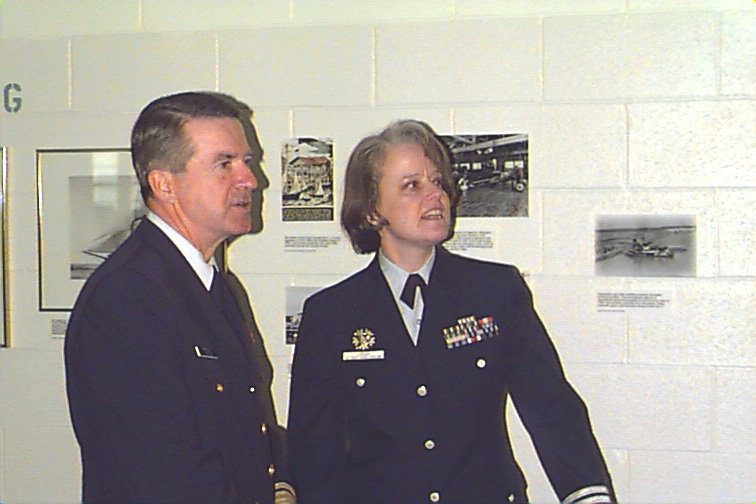 |
The author, C. Kay Larson, at the opening of the 60th
Anniversary Exhibit of the Coast Guard Academy in New London CT, April 10,
1999 with Superintendent Rear Admiral Doug Teeson. |
 Return to the New York
Military
Affairs Symposium start page
Return to the New York
Military
Affairs Symposium start page