REVIEW by George A. Rasula
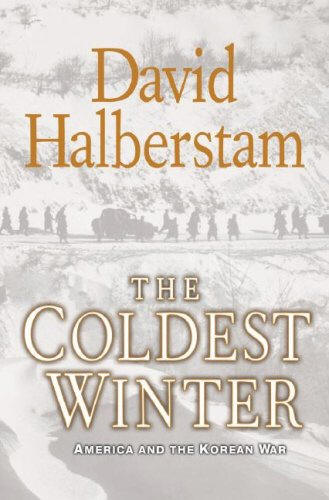
THE COLDEST WINTER by David Halberstam
 The book contains well
written essays about a few combat actions. On the whole, however, it was
disappointing.
The book contains well
written essays about a few combat actions. On the whole, however, it was
disappointing.
The author focuses on personal stories at the expense of
explaining the battle. This is a questionable choice where material that could consume
volumes here was condensed into one, albeit 669 pages. The Seoul coverage is
overshadowed by comments about personal retribution and is nearly silent about the
combat actions of the 1st Marines (Puller), 5th Marines (Murray), 7th Marines
(Litzenberg), or even the Army’s 32nd Infantry which also played an important
role.
My personal experience in Korea began as a junior officer. I knew
little about the country, but learned quickly after debarking at Inchon in the summer of
1948, where I witnessed 30‐foot tides. Later I served as an aerial observer along
the 38th parallel. By mid‐1949 we left Korea with only USAFIK [US Armed Forces in
Korea] advisors [KMAC] assigned to ROK [Republic of Korea] units. We were all convinced
that Korea was ready to explode, and that the withdrawal of U.S. combat forces from
South Korea would open the door for Kim Il Sung.
Because I had worked with
former Finnish army officers in Alaska, I was assigned to Hokkaido, the northern‐
most island of Japan. During the winter of 1949‐50 with King Company 3/31of the
31st Infantry Rgt. in Hokkaido I looked forward to good skiing and spent most of my time
organizing and supervising the regiment’s winter training
program.
Halberstam repeats the conventional early war reports that the Army
was not trained ... they spent most of their time in geisha houses. These negative
stories ignored the training programs of units elsewhere in Japan. It may have been that
way around Tokyo, but near Sapporo we had an effective winter training program, using as
background the 1939‐1940 Winter War of Finland. Army veterans from Chosin have
said “I survived Chosin and three years in prison camp because of the winter
training I received in Hokkaido.
The divisions in southern Japan were the
first to go, FECOM [Far East Command] drew many key personnel, junior officers and
experienced NCOs from our regiment as fillers for those divisions. As a result the 7th
Division was reduced to less than half authorized strength and had to be rebuilt from
the pipeline arriving from the States. This, obviously, did serious damage to unit
integrity, and compromised individual and unit training. The Marine Corps had a similar
problem since they didn’t have a full division at that time. The Army, without
touching forces in Europe, would eventually field more than five division forces in
Korea. It was on‐the‐job training for the early divisions to resist the
North Koreans pressing against the Pusan perimeter. For the infantryman, the basic
on‐the‐job training is kill or be killed.
Halberstam
repeatedly refers to the rift between USMC Gen. O.P. Smith and Army Gen. Ned Almond, at
the expense of other subjects. This fits into his focus on the Marine role at Chosin to
the detriment of the Army contingent which suffered more killed and missing than the
entire Marine Division did during their experience in northeast Korea. It was after the
move into Seoul when the differences between Smith and Almond developed, with Almond
urging Smith to go faster and take Seoul at a time when the North Korean forces were
falling apart. This was also the beginning of the blame‐game; i.e., finding
anything that went wrong was Almond’s fault because he was too aggressive. At this
time the Marines were remembered from World War II as an aggressive offensive force. So
what explains Smith’s tendency to hold back and build up before pushing forward?
Inter‐service rivalry during the Korean War was voiced most often by
Marines and may have started as far back as 1947 during the reorganization of the
Defense Department. There are many sides to each story. What one accepts often relates
to one’s military service affiliation. Halberstam repeats the tale that Marine
officers preferred to eat cold C‐radios and sleep on the cold ground. That can
only bring smiles to Army officers who have eaten with the Marines.
Smith was slow
and cautious. In my detailed studies of his Aide‐Memoire I searched for signs of
initiative based on his mission ‐‐ finding the enemy ‐‐ but
I found none. I have formed the opinion over these years that General Oliver Smith
exercised no command supervision over Army units east of the Reservoir after they were
attached to his command the evening of 28 November.
MacArthur got credit for
insisting on the landing at Inchon. Having been stationed there and observed the extreme
tides I thought MacArthur was very lucky to have had the weather on his side. After
providing very little detail about the tactics and casualties during Inchon, the author
continues with more stories about the Smith‐Almond personality conflict at Seoul,
saying little about the enemy other than to infer that there were more of them than
originally estimated
Smith’s belief that Almond was risking his Marines
unnecessarily is a conclusion that is difficult to accept today, after more than five
decades of hindsight. Smith complained, held back, and never was aggressive. His
experience as the “Professor,” who attended the French Ecole de Guerre in
1934, may have influenced his role as an officer. While Almond was actively visiting
subordinate units where he gained an understanding of the situation on the ground, Smith
spent most of his time in his command post. About the second day of Chinese attacks on
Yudam‐ni where no one commander was in charge, Colonel Al Bowser suggested he be
sent to assume command. General Smith did not agree, and as a result the two regimental
commanders at Yudam‐ni worked in cooperation with each other, contrary to the
principle Unity of Command.
The problems of splitting the command are obvious
to anyone with military command experience. However, the problem of attaching Tenth
Corps to Eighth Army is obvious to those with knowledge of the landscape. Korea is
separated by many mountain ranges, terrain which does not lend itself to mutual support.
On the night of November 25 when the Chinese attacked Eighth Army units
Halberstam says: The Chinese had precise intelligence on the Americans, and the
Americans on the west coast—the Marines on the east were shrewder and better
led—were essentially blind to the trap they had walked into. I find it difficult
to understand Halberstam’s rationale when two Marine regiments walked into a
Chinese trap at Yudam‐ni. The Chinese were uncovered because of the westward
attack ordered by Almond. Smith took 14 days to move his lead regiments 14 miles to
within artillery range of the oncoming Chinese, without knowing they were there. In
Korea to be road‐bound was a self‐imposed weakness, especially if one does
not exercise the principle of Security and use effective reconnaissance to the front,
flanks and even the rear.
Halberstam makes an important point that the Chinese …
were much less encumbered by heavy weapons, ammunition, and food than the Americans, and
that lightness was their strength (and would eventually be their weakness as well).
However, he does not elaborate so the reader would understand that this weakness against
a well armed force is what defeated the Chinese and made the breakout possible at the
Chosin.
Much of the author‘s information is either not true or is
exaggerated hype of the past. Halberstam compares the 2d Infantry Division to the 1st
Marine Division: to understand …. what a great division commander might have done, it is
only necessary to know what Major General O.P. Smith, his counterpart ... in
Almond’s Tenth Corps, did. The Marines were not supposed to advance to the border.
We read Almond was relentlessly aggressive and abrasive. To write
that Smith not only saved the First Marines from total destruction, but saved
Almond’s command as well, and that he believed the Chinese were there in large
numbers, is based on hindsight. This statement reflects Halberstam’s losing sight
of the battle by being consumed with the personality problems that are reported to have
existed at that time, problems that had nothing to do with the eventual outcome of the
Chosin campaign.
Who saved the 1st Marine Division from total destruction? The
answer is not found in Halberstam’s Index because the name “Rees” was
not referenced. David Rees wrote in his Korea: The Limited War These terrible losses
[east of Chosin] had to be placed against the saving of Hagaru itself, and with it the
Marine Division. Beyond that, saving Almond’s command would not have been in the
cards because he still had the 3d Division, two‐thirds of the 7th Division, the
ROK II Corps and the immense firepower of Corps artillery, anti‐aircraft and
armor, all assembling in the Hungnam perimeter. As corps reserve, they could have been
called on to save the Marine Division. Ignoring the myth and hype, we must conclude that
Smith was saved because of the inability of the Chinese to equip and support their own
forces. Al Bowser believed the Hagaru‐ri supply dumps may have saved the Marines,
while the lack of Chinese supply dumps is what prevented the enemy from accomplishing
his mission. They had the numbers; we had the bullets ‐ and Tootsie Rolls.
In two chapters—30 and 34—Halberstam, in a mere 22 pages,
offers an incomplete and unsatisfactory version of what happened during the Chosin
campaign. Halberstam continues to be more interested in rhetoric about Almond, such as
the arrogent, blind march to disaster, ill advised and unfortunate, work of madmen, pure
insanity. He still believes that Almond set out to cross the Taebaeks to link up with
Walker’s force. Halberstam speculates about a U.S.M.C. link up with Walker’s
men, but apparently neglects to note that the boundary between Eighth Army and Tenth
Corps had been moved to the west. The Marines’ attack west was intended to apply
pressure against the enemy’s rear area, and his supply routes supporting Chinese
units in battle with Eighth Army, but the plan was implemented too late with too
little.
What Halbersham describes as the big drive north was actually an attack
west from Yudam‐ni through fifty miles of switchbacks through mountainous terrain
which, if opposed even by light enemy opposition, would have taken a week or more.
Emphasis was still on buttoning up at night rather than sending more eyes and ears to
the other side of the next mountain. A westerly move would have faced delays caused by
deep snow, for which the division was not equipped, and the coming intense cold normal
of December and January. Up to this point, it had been about twenty below, although
often at double that. An honest appraisal came years later from General Matthew B.
Ridgway. I find it amazing that highly trained professionals with extensive combat
experience could have approved and tried to execute the tactical plan of operation for
the X Corps in northeast Korea in November 1950. It appears like a pure Map Exercise put
on by amateurs, appealing in theory, but utterly ignoring the reality of a huge
mountainous terrain, largely devoid of terrestrial communications, and ordered for
execution in the face of a fast approaching sub‐arctic winter. —Mossman,
Ebb and Flow, p.47, n.39, Ridgway, MS review comments, 27 Feb 85.
The
author’s discussion about Gen. Willoughby is the most detailed I have ever seen.
Willoughby’s problems included the inability to deal with reality which, for an
intelligence staff officer is deadly serious. The acts in MacArthur’s headquarters
of distorting combat level intelligence by blocking other sources and failing to react
to Chinese radios going silent in late October needed investigation. Veterans of the war
continue to believe that the “Forgotten War” was a map exercise to those at
the Dai Ichi [FECOM] in Tokyo.
The author incorrectly reports the Fifth Marines were already too
isolated for their own good. The Chinese plan called for their attack to begin when the
Fifth Marines were east of the reservoir, but the Chinese were not ready. The Corps plan
actually saved the Fifth Marines by having them move to Yudam‐ni, thereby
creating a favorable mass of two regiments that faced the Chinese attack that night,
November 27‐28. Clay Blair was right, it was ill‐advised and unfortunate,
especially unfortunate for the Army units of RCT‐31 that had just arrived to
relieve the Fifth Marines the day the Chinese attacked.
From November 28 Chesty
Puller and his staff are described as extremely nervous. Soldiers of 2/31 saw enemy
observers and patrols every day in the hills southwest of the perimeter, at times
reporting thousands of Chinese marching south toward the Funchilin Pass. It was after
the arrival of 2/31 Infantry on 1 December when the Chinese finally blew a hole in the
bridge for the second time. The enemy was also running out of food and ammunition, were
apparently busy seeking shelter form the cold.
The bridge in the Funchilin Pass
highlights a serious failure regarding principle of war—security. Halberstam
continues his blame‐game, stating that Smith was now sure that the Chinese were
baiting an immense trap for him ... the Chinese failure to blow the bridge in the pass
and that they wanted the Americans to cross it—it was virtually an invitation
which meant nothing to Almond. The facts do not justify this statement. The author
identifies the bridge as a very important security problem but does not discuss General
Smith’s failure to take action to secure that critical sector of terrain and its
bridge to insure it remained passable as a critical part of his main supply route. He
did not give col. Puller, the commander responsible for that sector, the mission of
securing the bridge.
Halberstam fails to provide details about repair of the
blown bridge in the Funchilin pass, an engineering feat which was equal in importance to
the construction of the airstrip at Hagaru‐ri. The installation of the Treadway
bridage was, without a doubt, the best example of inter‐service cooperation
during the entire Chosin campaign.
Halberstam reports that Smith believed that when the Chinese struck,
which he was quite sure they were going to do, leads one to believe that Smith’s
defensive attitude had existed since the 7th Marines were attacked at Sudong on
6‐7 November. But the enemy, more than a day before they made contact the night
of 27 November, had his assault units in position well within recon and artillery range
of two Marine regiments at Yudam‐ni, also east of Chosin where the 5th Marines
were being relieved by the arriving Army RCT‐31. The defensive mind‐set
continued to be button up for the night.
What are Halberstam’s sources for
statements about the ferocity of the battle at Sudong, saying it made Smith warier than
ever, that his job, he believed was to slow down the journey into the trap and not go
too far out on a limb. It took Smith 14 days to go 14 miles with no enemy opposition,
while Chinese soldiers marched long distances each night from their assembly areas north
of the Yalu River. The commander must capture more than one prisoner so as to find out
if interrogations match. The intelligence staff officers must encourage the commander to
make use of patrols to the front, flanks and yes, even the rear.
Of Almond’s
personal interrogation of the prisoners taken at Sudong, Roy Appleman wrote: Almond
considered this news of paramount importance. When he immediately communicated this news
to the Far East Command, it seems clear that the command did not take this intelligence
of strong Chinese forces in northeast Korea as seriously during the next two weeks, as
did General Almond. I looked at Halberstam’s Index to find Appleman, but he
wasn’t there. On the other hand, while Martin Russ is noted on only two pages in
the Index, in Chapter 30 Notes Russ is cited eight times. Although Appleman has been the
accepted expert on the history of Chosin, his name comes up only once in Notes.
Halberstam seems to be selective in the use of his sources.
The author states that Smith, in his letter to Lt. Gen. Clifton B. Cates,
said he had no orders to pursue the enemy. This is a serious error as General
Smith’s letter does not contain such a statement. If the enemy withdraws then he
is at his weakest and is vulnerable to pursuit. If the commander is not sure he should
pursue because of his own situation, he should immediately contact his superior and
concurrently push his recon forward to maintain contact with the withdrawing enemy
units. Smith did not notify Almond of his non‐pursuit, nor did he initiate
effective recon.
Map 15: Marine Sector, on page 436, shows Hungnam to the Chosin
reservoir area, Marines at Yudam‐ni and two army battalions east of Chosin, but
does not explain where the Army units came from or how they got there. We also note the
failure to show Koto‐ri and Chinhung‐ni on the map, although the text
mentions Marine battalions at these towns.
Almond’s visit with Lt. Col. Don C. Faith on 28 November is probably
the most overworked story of the 31st RCT east of the reservoir. Why have authors been
spilling so much ink over this subject?
Almond flew into Faith’s location as
he did earlier with other units, and awarded some Silver Star medals. The 5th Marines
did make contact with the Chinese in strength when 2/5 attempted to attack west on 27
November. Why did Almond say there weren’t many Chinese present and Faith was
going to attack all the way to the Yalu? Repetition of this hearsay continues to infer
that he didn’t know what was going on. As a corps commander visiting a front line
battalion attempting to encourage the offensive after they had faced their first contact
with the enemy, Almond was showing the flag for public consumption. Survivors of the
action east of Chosin regret that Almond did not visit the other two battalion
commanders—Reilly and Embree—who were both severely wounded, for there he
would have received a far better feel for what had happened the previous
night.
Chapter 34: The leadership at the top in the Second Division had been
terrible. By contrast, because O.P. Smith had anticipated what the Chinese were going to
do, the Marines were in much better shape. Smith did not know what the Chinese were
going to do, according to his own Aide‐Memoire. They were not better connected
because he had stood up to Almond, rather, but because he followed Almond’s Tenth
Corps orders to launch an attack on 27 November to the west from Yudam‐ni where
they suddenly found the Chinese in strength.
Halberstam’s claim that the Marines were “fortunate
….that the Chinese struck when they did” is based only on the premise that the
Chinese could have delayed their defensive action against the attack which would have
allowed the 5th Marines to move further west to be cut off in more favorable terrain.
The Chinese were in a blocking position and did not attack the Marines; it was the
Marines who were attacking. The first Chinese attack against Marine and Army units at
Chosin began late the night of 27‐28 November.
His second point, that the
Chinese had such poor communications and so little ability to adapt to the changing
realities of battle relates not only to the time of the 5th Marines attack. The Chinese
had planned to launch their attack one or two days earlier, 25‐26 November in
coordination with the attack against Eighth Army. Had they done so the Marines would
have been caught with one regiment on each side of the reservoir. The Chinese inability
to properly communicate, equip and supply their forces allowed the Marines to escape.
The author discusses his version of classic movements, masterpiece of
leadership, fighting a vastly larger force and the most celebrated, without providing an
understandable basis to support these positions. The breakout was successful because of
leadership and drive at the lowest levels, the rifle company and its supporting weapons,
for they are the Marines and soldiers who make up the casualty lists. The book fails to
describe details of combat action.
General Smith wrote that his division had been opposed by elements of
six CCF divisions. The Chinese did not have the capability of coordinating and directing
attacks by large organizations because their ability to communicate with troops on the
fighting front was limited to voice commands, bugles, whistles and flares. This limited
them to attacking with platoons and companies responding to voice commands directed at a
single objective. After achieving an objective they didn’t know what to do when
American defensive firepower descended on them, often changing limited success to
disaster.
There are some very good short stories (p. 549, et seq.) such as
Operation Roundup where again Almond is accused of mishandling communications, leading
to nasty results. The author notes the inability of the Chinese commander to make
changes due to the situation at the moment, in one case resulting in the slaughter of
thousands of Chinese soldiers because they continued to march in the direction ordered.
It turned into a “turkey shoot” at Wonju when they were spotted by an
artillery observer. The dash of the Fifth Cavalry Regiment under Crombez to Chipyongni
also is discussed but is laden [p.567/45] with words such as unnecessary recklessness,
unnecessary losses, cavalier disregard. Some believe could have been achieved with fewer
casualties, but Crombez had a mission and he achieved it. Rather than
fault‐finding, critics should describe the options available. Halberstam fails to
do so, both here as well as at the Chosin campaign.
The author closes out 1950 in Chapter 34 in which Almond was
protected politically in Tokyo, then says that complete destruction had been avoided
because of O.P. Smith’s virtual insubordination. By deriding Almond through these
many pages rather than telling the readers about the battle, Halberstam indulges in
character assassination rather than address the battles and missions of military units.
Soldier‐survivors continue to hope for the return of the remains of more than
one‐thousand fellow soldiers from the battleground east of the Changjin (Chosin)
reservoir. They are the ones who made the breakout possible.
I frequently wondered
what was going on in other organizations of Eighth Army while reading.
In early
February the 2d Division became part of Tenth Corps and had in effect replaced the First
Marines, whose commander had made it clear that they did not want to serve under Almond
again. (p. 514/fn39) This chapter has twenty‐two google hits on Almond, all with
a negative slant. (517) Alexander Haig enters the stage here as Almond’s aide, at
the Chosin.
The next day, Ned Almond ordered the 23IR right back to the area,
expecting it immediately. (p. 531/fn41) He wanted the Chinese cleared out and he wanted
prisoners. By then, Almond was hardly a welcome figure around regimental headquarters,
already regarded by many of the senior officers (much as he had been by the First
Marines) as a bully, seeming to meddle, and constantly interfere to demonstrate his
superiority.
There is a good description (p. 533) of one of the great mysteries of
combat, the process of going from green, scared soldiers to tough, combat‐ready
(but still scared) veterans. It was a universe without choice, the most primal on earth
that turned ordinary, peace‐loving, law‐abiding civilians into very good
fighting men. Suddenly they could fight almost by pure instinct. (534) No soldier ever
learns this until he has been at the receiving end of enemy fire. I remember how it
suddenly struck me when I was wounded at Peleliu, a feeling that I cannot describe
today. No fear, no horror, just the frustration of being taken out of the action at that
moment; awakening in a tent, watching a doctor probe into the eyeball of a soldier in
the next cot, and feeling lucky because I was watching with two eyes.
The Consequences: After highlighting the miscalculations which are the
product of all wars, the author states that perhaps even more important, the Chinese
entrance into the war had a profound and long‐lasting effect on how Americans
looked on the issue of national security. [p. 631/fn53] In my classroom experience at
the Infantry School in 1954, then later at the Command & General Staff College in
1958, we focused on a possible nuclear war and reorganized our divisions into a pentomic
configuration. However, by 1959 thoughts of atomic warfare were set aside as I found
myself advising an ARVN infantry regiment on the South Vietnam side of the Cambodian
border.
Halberstam’s statement that what happened in South Korea was
probably the most impressive and dramatic—ranking even above the success of the
Marshall Plan would be debatable among historians of international politics. [pp.
640‐41]
Veterans of the war were awakened after 40‐years by the
publication of Eric Hammel’s book Chosin, followed by Roy Appleman’s
East of Chosin and Escaping the Trap, then Clay Blair’s The
Forgotten War. Hammel’s book sparked the activation of The Chosin Few
which rapidly grew to almost five‐thousand members, organized in many regional
chapters. [pp. 644‐45] Survivors of Chosin at a reunion of the 31st infantry
Regiment decided it was time to let the public know that the Marines weren’t the
only ones at Chosin, so they organized the Army Chapter of the Chosin Few. From this
small association of like‐minded veterans came the historical justification for
the Secretary of the Navy to award (in1999) the Presidential Unit Citation to units of
the U.S. Army RCT‐31 that performed heroically east of Chosin, units that were
specifically omitted from Gen. O.P. Smith’s recommended list of Army units to
receive the award. I encourage military historians to continue their inquiry into the
command performance of Maj. Gen. O.P. Smith during the time the Army units east of
Chosin were attached to his command.
As a survivor of the Chosin campaign and serious student of battles in
the Korean War, I regret this book does not get five stars.
Colonel George A. Rasula, USA (Ret)
george@rasula.com
864‐654‐3911
 Return
to
the
New
York
Military
Affairs
Symposium
start
page
Return
to
the
New
York
Military
Affairs
Symposium
start
page